Water treatment on a farm: drinkers, drip irrigation, dairy block
On a farm, water from a single borehole goes out to users with incompatible requirements: the poultry or cattle house, the field under drip irrigation, and the dairy block. A system built for the whole site at once turns out expensive and still fails to cover any of the three. Here is what is critical on each branch and what belongs on it.
Why a farm never has a single water treatment point
The branches differ less in the composition of the water — it is the same for all of them, from one source — than in which part of that composition gets in the way, and in how the flow is spread through the day.
Irrigation draws the most, but it draws in windows: watering runs for two to four hours, and the flow within that window is several times the daily average. Salt content, on the other hand, matters little here — calcium salts do not bother the plant, they bother the emitter. The drinking lines use less water, and they use it evenly, all year round, yet the limits on iron, suspended solids and microbiology are the strictest on the site. The dairy block uses less still, but it is where the water is heated and where it meets detergent solutions and surfaces that later touch milk.
The only thing all three share is the inlet. Suspended solids, dissolved iron and manganese get in the way of the emitter, the nipple drinker and the heat exchanger alike, so mechanical and reagent-free filtration goes on the common manifold. Past that point the branches diverge, and there is no saving to be had on the divergence: a unit sized to the average will be more than irrigation needs and less than the dairy block needs.
Drinking water for livestock and poultry
A nipple drinker is a calibrated orifice with a shut-off element. A particle of oxidised iron or a grain of sand that lands on the seat causes one of two failures: the drinker leaks, leaving wet bedding under the line, or it passes less water than it should. Water intake is tied directly to feed intake, so a line that gives up its water grudgingly shows in the weight gain before anyone spots it on a walk-through.
The second constant problem is biofilm inside the lines. Small-diameter pipes, low velocities, warm air in the house and the organic residues left after solutions are dosed through the drinkers — everything fouling needs. The film clings to the pipe wall, breaks off in pieces from time to time, and goes straight into the nipple.
Hence the order of work on the drinking branch: take out iron and suspended solids before the line inlet, disinfect the flow at the supply, and flush the lines under pressure between batches. Disinfection does not replace flushing: ultraviolet treats the water inside the chamber and does nothing about what has already grown downstream of it.
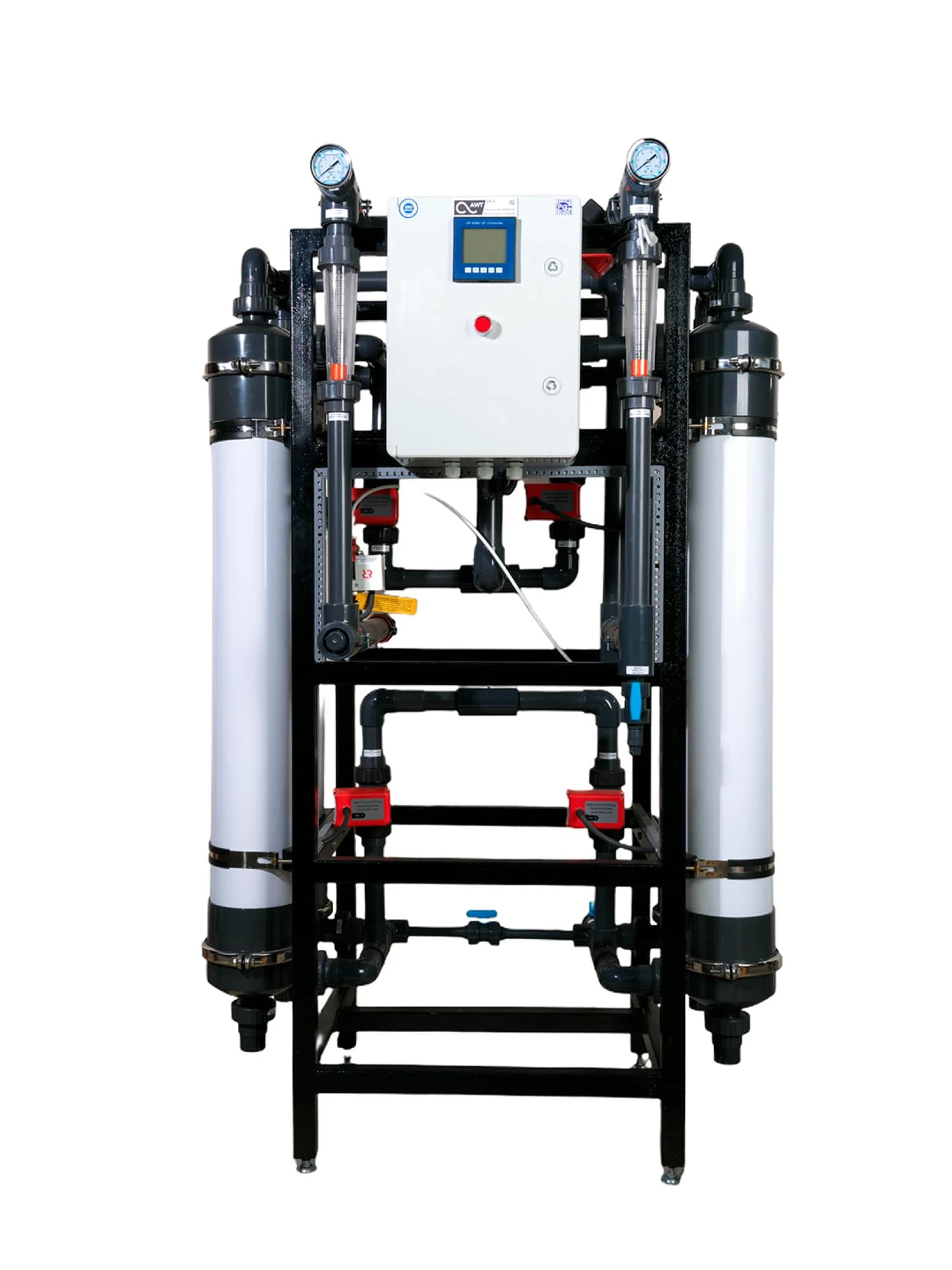
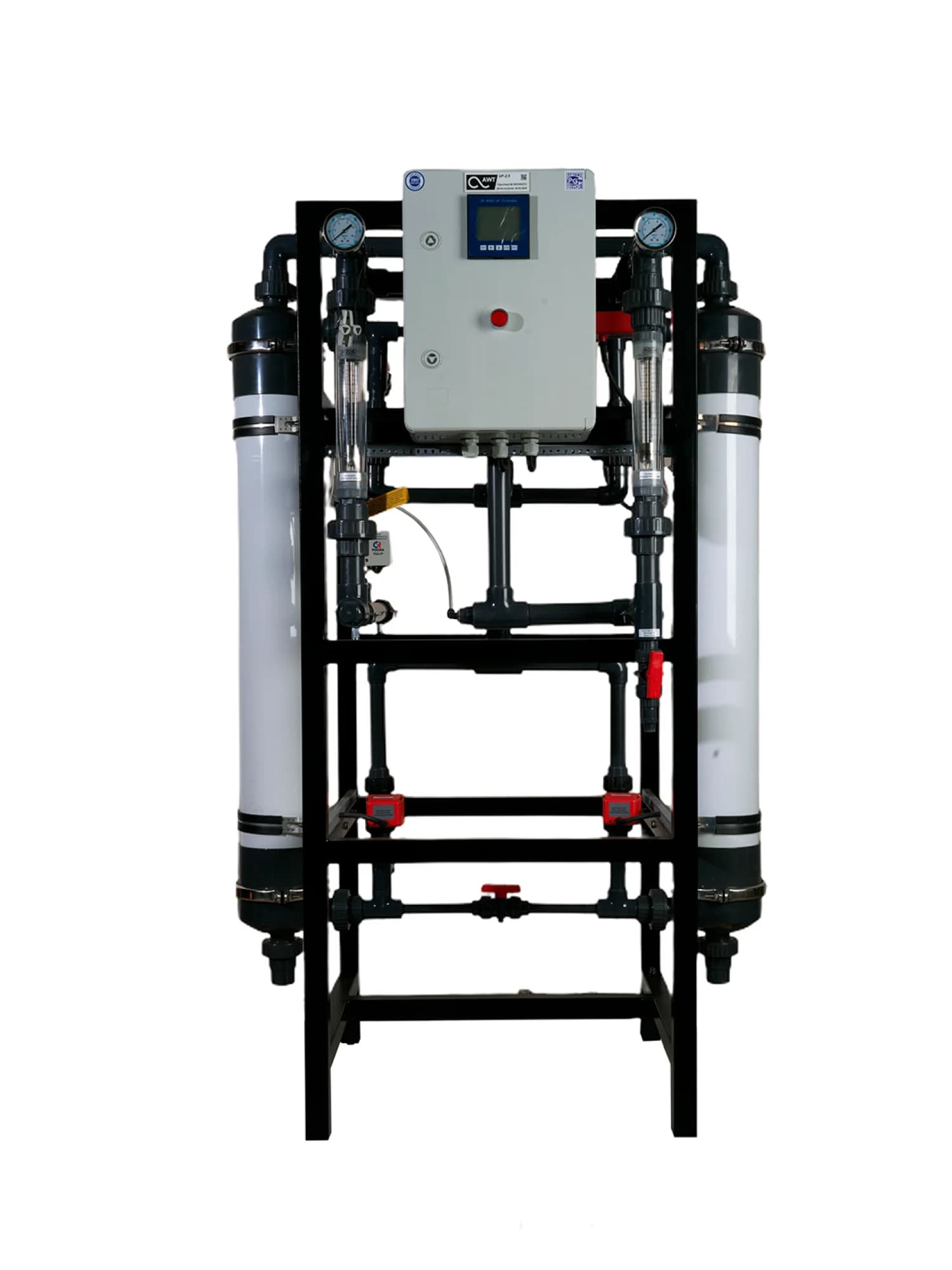
The UV unit on this branch is sized from flow and from the transmittance of the water, and the second matters more than it seems. The DUV-1A120-N AAT23 handles 10 m³/h at T=90 %, but only 5.8 m³/h on drinking water at T=70 %, and 3.6 m³/h on treated wastewater at the same figure. Small lines take the smaller models: DUV-1-21-N BAT23 — 2.1 m³/h, 24 W, G1" connection; DUV-1-87-N BAT23 — 7.5 m³/h, 95 W, G 2". Turbid water in front of the lamp means going a size up on the unit — filtration is the cheaper answer.
Drip irrigation: the enemy is not salt but emitter clogging
An emitter is a labyrinth channel passing a few litres an hour. It clogs in three different ways, and each calls for a different answer:
- ✓mechanically — suspended solids and sand from the borehole, algae and silt from a storage pond;
- ✓biologically — iron bacteria and slime, above all when the water carries dissolved iron that oxidises in the line on the way;
- ✓chemically — calcium and magnesium carbonates settle inside the emitter when the water left in the line evaporates after watering stops.
The trouble with drip irrigation is that a blocked emitter does not show at once: the plants show stress in patches weeks later, and a labyrinth cannot be cleaned out — you replace the line.
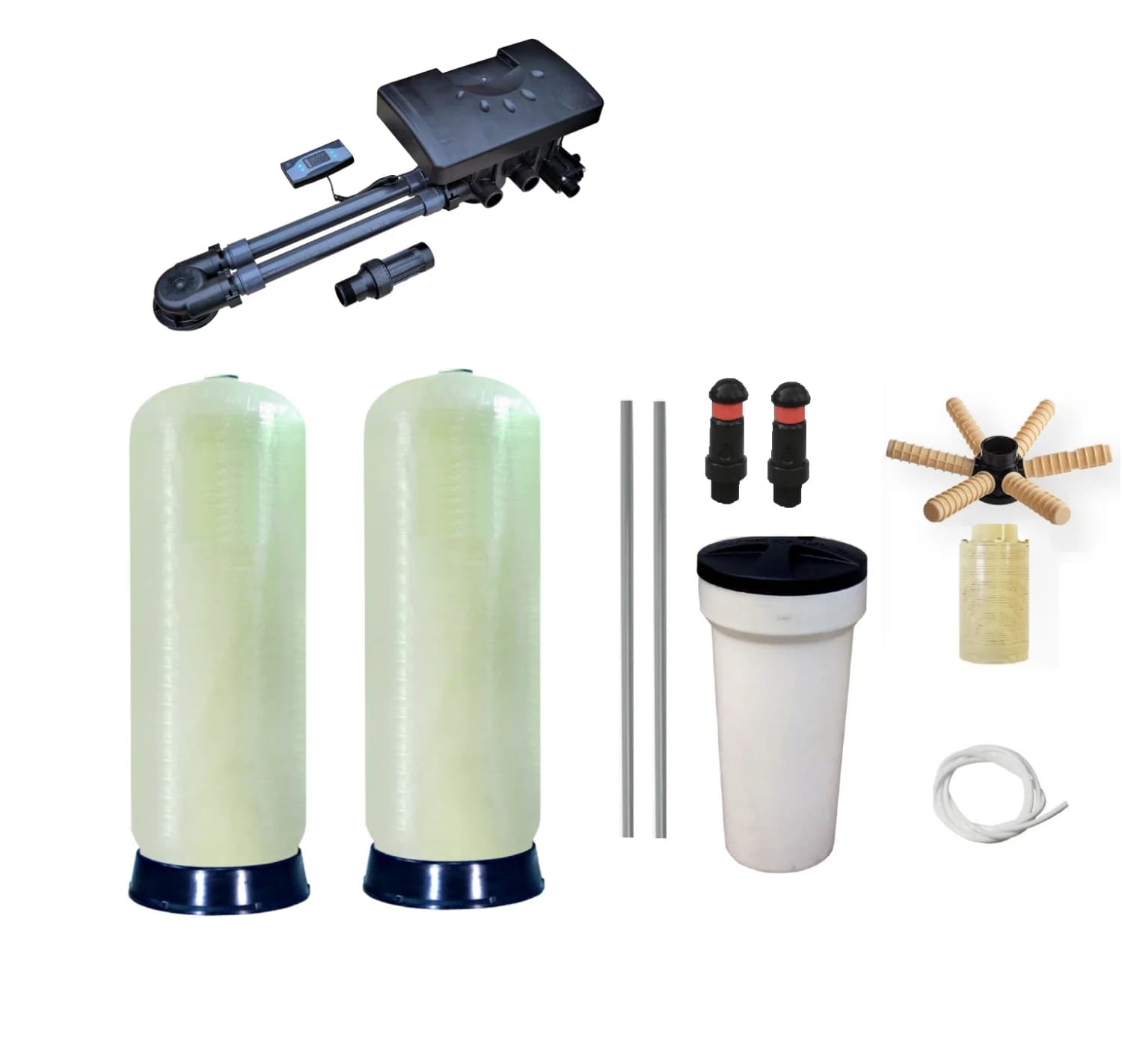
So filtration here is not an option, it is part of the system, and it is sized on the peak flow within the watering window rather than on the daily volume. Automatic backwash on this branch is not a convenience either: nobody stands by the filter while the field is being watered, and the pressure drop climbs fast. Vessels from 24 inches up come with the larger Runxin valves, with 2 and 3 inch connections and capacity from 10 to 50 m³/h; some models are side-mounted, cut into the vessel wall. Allow for the other side of automation too: backwash needs a reserve of water and enough drain capacity, and it occupies a window of its own, best kept clear of the watering schedule.
Fertigation adds a question of compatibility. Hard water high in calcium and magnesium, paired with a phosphorus-based solution, throws a precipitate right in the line and on the filter element; with sulphate solutions the same mechanism produces gypsum. The practical rule is simple: never mix incompatible solutions in one tank, and test compatibility with your particular water by mixing a trial batch in a bucket before the solution goes out to the field. Correcting pH and holding back salt precipitation is easier from a unit of its own — a dosing station: the HG30 and HP30 ranges offer 60, 100 and 200 l tanks, a digital or analogue dosing pump and connections from dn15 to dn50, 220 V supply. It belongs in a dry room, away from heat sources.
The dairy block and equipment washing
On the dairy branch the water is part of the washing. Hardness salts together with protein and fat residues build a dense layer on tank walls, in the milk lines and on the cooler plates — milkstone. That layer harbours microflora and slows heat transfer, so the cooler performs worse at the same load.
Hard water also ties up part of the alkali in the detergent solution. The result shows in consumption: more detergent goes than the plan allowed for, and the surfaces still do not come out clean. Raising the concentration does not fix it, because the cause is in the water, not in the chemistry.
The final rinse deserves a word of its own. It is the last time water touches a surface that will then touch milk, so suspended solids, microbiology and iron all matter — iron leaves both a deposit and a taste. The hot water branch adds scale on the heater and in the heat exchanger.
The dairy block uses little water next to irrigation, so its equipment ends up compact — and held to stricter requirements than anything else on the site.
Summary: what bothers whom and what to install
| Consumer | What is critical in the water | What goes in the system |
|---|---|---|
| Drinking water for livestock and poultry | iron and suspended solids on the nipple seat, biofilm in the lines | reagent-free filtration with an automatic valve, UV at the supply, a line flushing routine |
| Drip irrigation | suspended solids, iron, carbonates inside the emitter | filtration sized on the peak flow of the watering window, dosing to correct pH and hold back salt precipitation |
| Dairy block and CIP | hardness, iron, microbiology at the rinse | softening, filtration ahead of it, disinfection on the rinse branch |
| Washing of yards and vehicles | suspended solids and pressure | coarse mechanical treatment, minimal requirements for salt content |
What next
Collect three things. First, a laboratory report on the water from the source: iron, manganese, hardness, turbidity, colour, microbiology. Second, the flows for each branch separately, and for irrigation the peak flow within the watering window rather than the daily volume. Third, the water reserve and the discharge point for backwash: a filter with an automatic valve backwashes briefly but at a high flow, and on site that water has to go somewhere.
With those figures you can turn to automatic filtration units — they take out iron, manganese and hydrogen sulphide along with turbidity and colour, and without reagents. That is the common inlet where all three branches begin. If you have no analysis yet, start with one: on a farm, sizing equipment from a verbal description of the water ends with replacing the irrigation lines.