Water after reverse osmosis: remineralisation, pH and what natural media actually do
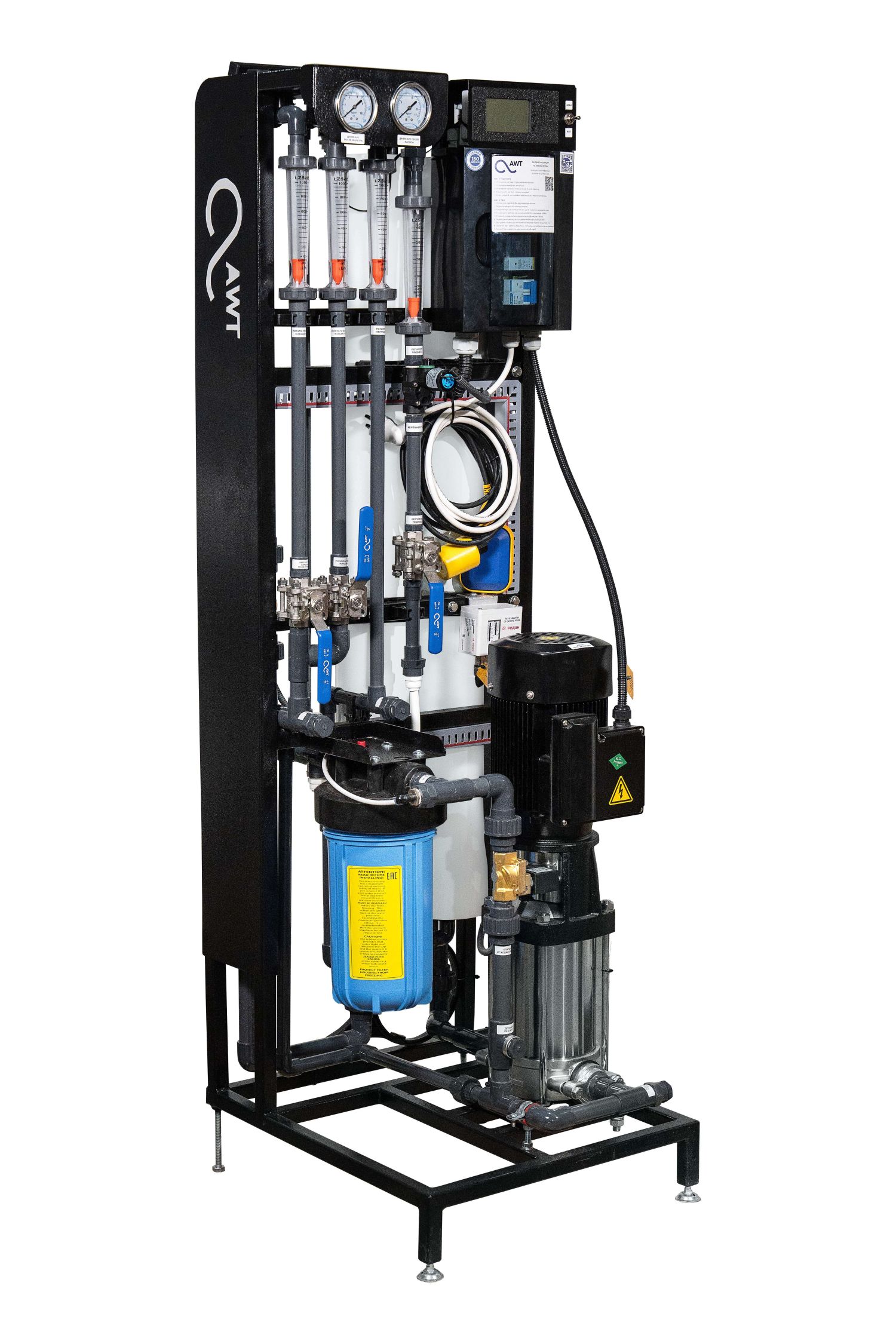
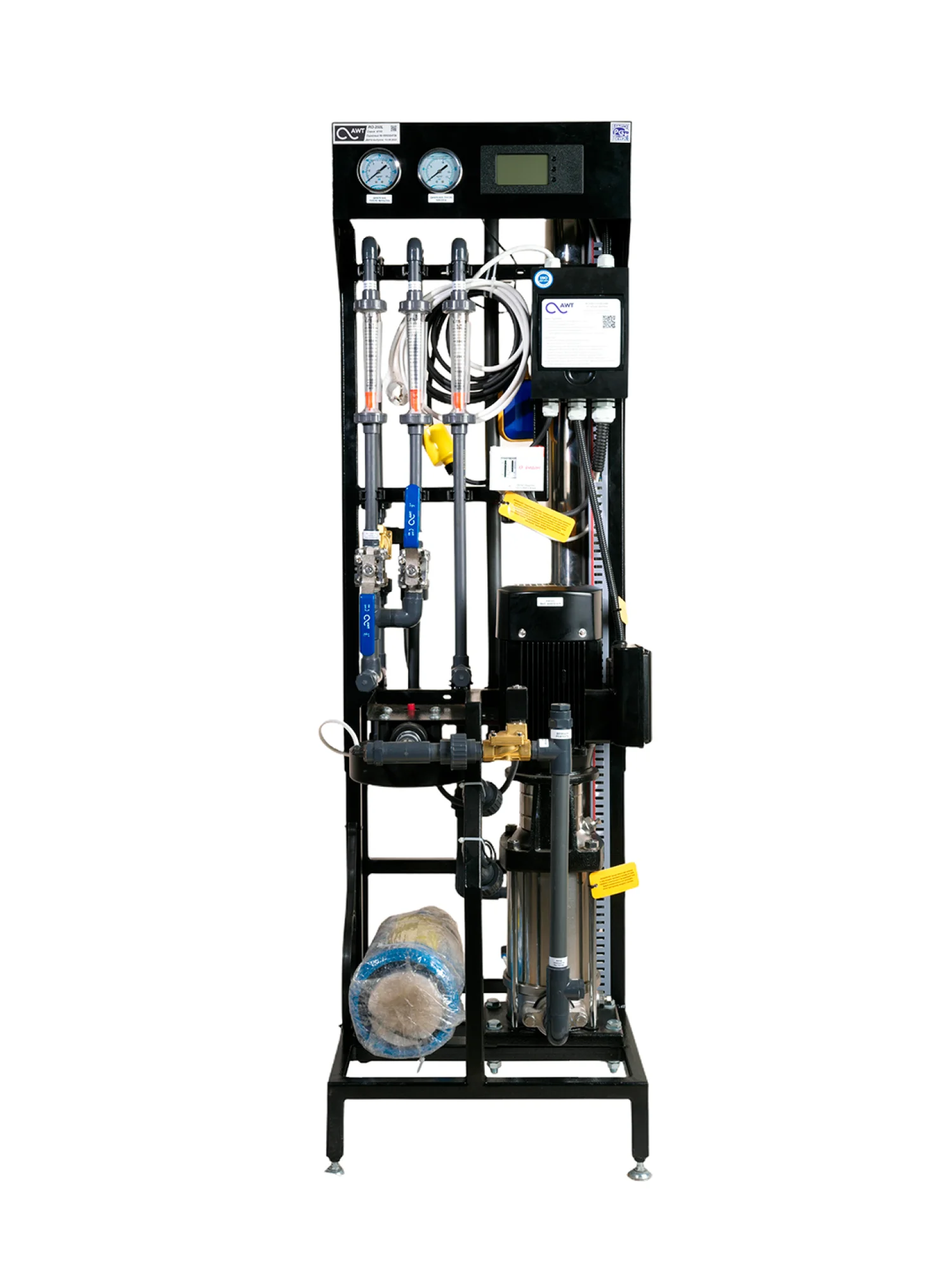
Reverse osmosis removes almost all salts from water, and that is exactly why the water is rarely ready for the consumer afterwards: it is acidic, poor in calcium and magnesium, corrodes metal and makes coffee flat. The task is solved by post-treatment conditioning, and the market often offers to solve it with "natural stones". Below we look at which media actually change water composition, which work as an ordinary filter, and in what order to assemble the stage after the membrane.
Why water after the membrane is aggressive
The membrane retains ions but passes dissolved gases. Carbon dioxide passes into the permeate almost completely, while the bicarbonates that balanced it stay in the concentrate. As a result, permeate pH usually drops to 5.5–6.5, alkalinity becomes close to zero, and total dissolved solids are a few to a few dozen mg/L.
Such water is undersaturated with calcium carbonate and tends to dissolve it. Its Langelier index is clearly negative, which signals corrosion: the water strips the protective layer from steel and copper pipes and leaches metal from brass fittings and boilers. How to read the index from an analysis is described in the article on the Langelier and Ryznar indices. For drinking and beverages, low mineral content means a bland taste, and for espresso, under-extraction; details for a coffee shop are in the article on water for a coffee shop.
Hence two different tasks for the polishing stage. The first is to return calcium, magnesium and alkalinity to the water and raise pH to equilibrium. The second is to remove residual taste and odour. Media that solve one task usually do not solve the other.
Calcite and dolomite: remineralisation by dissolution
Calcite is crushed natural calcium carbonate. When acidic water passes through the bed, carbonic acid dissolves it: calcium ions and bicarbonate pass into the water, and pH rises. The process is self-limiting: as equilibrium approaches, dissolution slows down, so it is hard to over-alkalise water with calcite. The increase in hardness and alkalinity depends on the initial amount of carbon dioxide and the contact time, and it has to be checked by measurement, not estimated by eye.
Dolomite and half-calcined dolomite add magnesium to calcium and act faster. Magnesium oxide in blends raises pH sharply, and at low flow or after a long standstill the outlet water can become alkaline. That is why such media are usually blended with calcite, with the proportion chosen from the analysis.
Both media are consumed: the bed dissolves and has to be topped up. The bed must be loosened periodically by backwashing, otherwise it compacts and water channels through it. Another option is to blend part of the pretreated raw water into the permeate: it is cheaper, but it also returns what the membrane was supposed to remove, so it only suits good raw water.
At large flows, a media remineraliser is replaced by dosing. A dosing pump feeds a solution of calcium and magnesium salts or an alkaline reagent into the permeate, with the dose tied to flow and corrected by outlet pH. Such a unit takes less space, needs no media top-ups and holds the target composition precisely, but requires reagent control and calibration. Stations of this type are collected in the dosing section. The choice between media and dosing is usually decided by flow, required accuracy of composition and who will service the unit: media are easier to keep without permanent staff, dosing suits sites where water is checked daily.
Shungite, zeolite, quartz and carbon: what they do at the polishing stage
Shungite is a carbon-bearing rock. Its carbon fraction adsorbs some organics and residual chlorine, in roughly the same role as activated carbon, although crushed shungite usually has a lower adsorption capacity. It adds practically no calcium or magnesium to the water and does not noticeably raise permeate pH. Before first use it is rinsed for a long time to remove dust. Water that has been in contact with shungite has no confirmed therapeutic properties, and they must not be promised.
Zeolite is a natural aluminosilicate with ion-exchange properties. It selectively takes up ammonium and partly heavy metals, so it is useful on raw water, not after osmosis, where these impurities are already gone. It is not a remineraliser.
Quartz sand and gravel are chemically inert. They are a mechanical filter and a support layer under other media.
Activated carbon at the polishing stage removes residual taste, odour and chlorine if the water was chlorinated after the tank. Its weak point is microbiology: bacteria multiply in a stagnant carbon bed, so carbon is placed before disinfection, not after.
Comparing polishing media
| Medium | What it changes | What it does not do | What to watch |
|---|---|---|---|
| Calcite | calcium, alkalinity, pH to equilibrium | does not remove taste or organics | media consumption, top-ups, backwash |
| Dolomite and magnesium oxide blends | calcium, magnesium, pH | does not remove taste | risk of alkaline water after standstill |
| Shungite | some organics and chlorine | hardly remineralises | dust rinsing, no promises of properties |
| Zeolite | ammonium, some metals | does not remineralise | more useful on raw water |
| Quartz | mechanical particles | does not change water chemistry | support layer role |
| Activated carbon | taste, odour, chlorine | does not remineralise | bacterial growth in a stagnant bed |
How to assemble the polishing stage
The order of units follows from their weak points. First comes the remineraliser: calcite or a blend sized for the unit's flow. Then, if needed, a carbon filter for taste. The UV steriliser comes last, because the storage tank and the carbon bed are places where biofilm can grow. Natural media are installed only after full treatment: if the raw water contains iron, manganese or bacteria, they are removed by pretreatment and the membrane, not by the polishing stage.
Monitoring is simple and regular. At the outlet, measure pH, total dissolved solids (TDS) and, if needed, total hardness and alkalinity. A rise in TDS and pH shows that the remineraliser is working; a drop shows that the bed is exhausted or channelling. It is convenient to take the first readings daily during the week after start-up to see how composition depends on flow and standstills, and then switch to weekly checks. If water stands in the tank overnight or at weekends, a reading after the first morning draw shows the worst case. For coffee equipment, the target range of hardness and alkalinity is usually given in the coffee machine requirements, and the polishing stage is tuned to it.
What next
To select a polishing stage, you will need an analysis of the raw water, permeate data (pH and TDS after the membrane), flow and operating mode, the purpose of the water and the pipe material downstream of the unit. If the water goes to coffee or beverages, add the hardness and alkalinity requirements from the equipment supplier.
Osmosis units are collected in the reverse osmosis section, disinfection after the tank in the UV sterilisers section, and ready-made schemes for food service in the water for cafes and restaurants section.