Turbid river water: lamella clarifier or DAF flotation
After a downpour, water from a river or a mountain stream turns turbid within hours, and filters sized for clear water clog within a day. Filtration and membranes need a clarification stage in front of them, and the choice is usually between a lamella clarifier and dissolved air flotation (DAF). The answer depends not on the equipment but on what exactly is suspended in the water.
Settle it or float it: the key question
Every clarification stage separates suspended solids from water through a difference in density. A particle heavier than water is easier to settle. A particle lighter than water, or one that readily attaches to an air bubble, is easier to lift to the surface. A lamella clarifier takes the first route, a DAF unit (dissolved air flotation) the second.
River turbidity is most often mineral: clay, silt, fine sand, soil washed off the catchment. These particles are roughly two to three times denser than water. After chemical treatment they gather into flocs that settle readily. This is clarifier territory.
There is other water too. Ponds and reservoirs with summer algal blooms. River stretches below roads and settlements, where oils and petroleum products get in. Water with high colour from dissolved organic matter. Flocs formed from such solids are light and loose, they settle slowly, and air bubbles lift them easily. Here flotation has the advantage.
So the starting point is not which unit is more complex or newer, but how the solids of this particular river behave, on an ordinary day and after a downpour.
How both units work
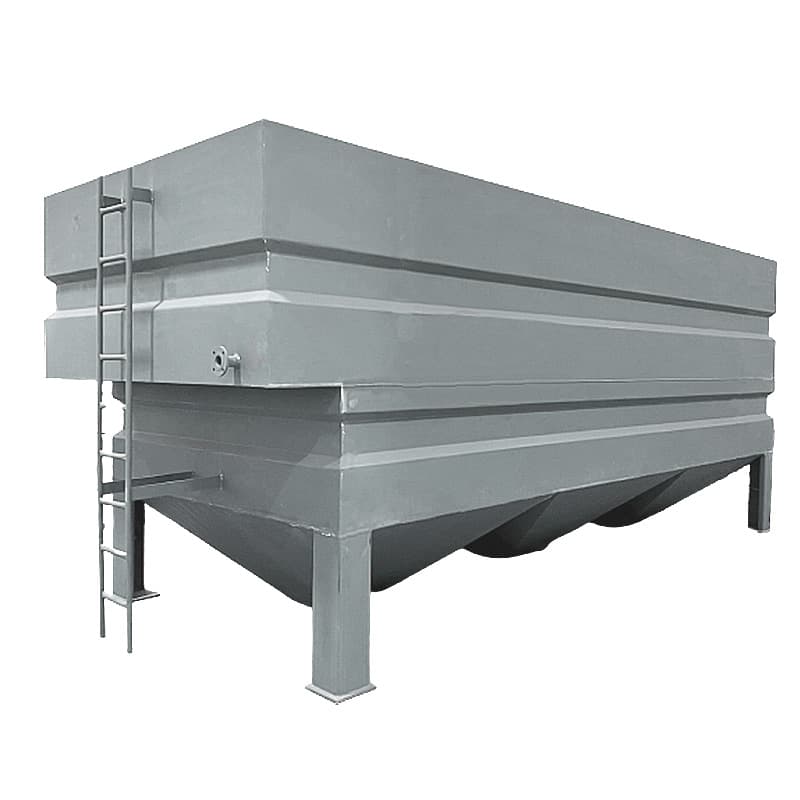
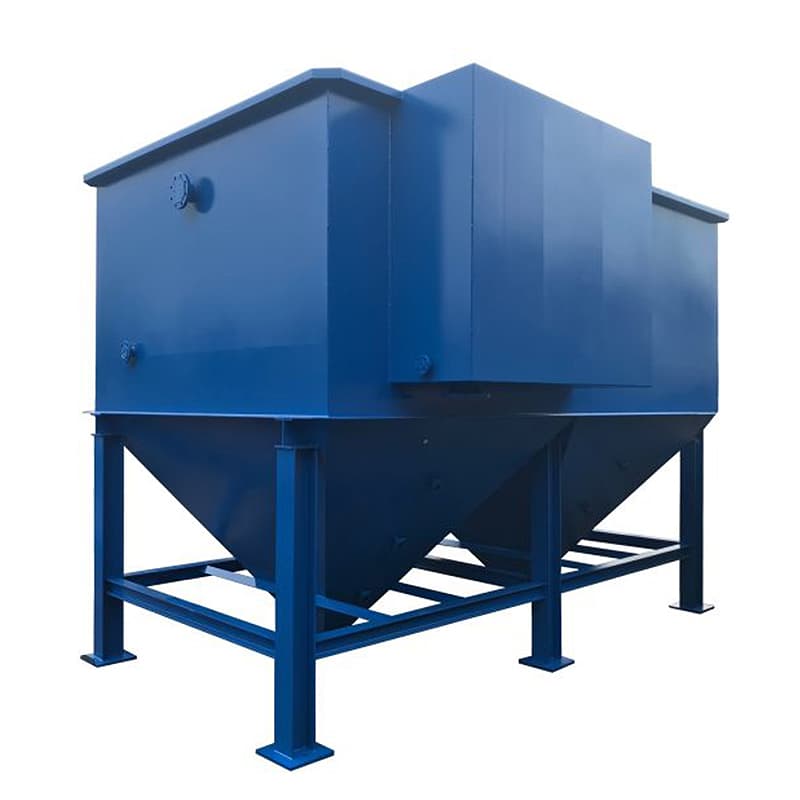
A lamella clarifier is a tank with a pack of inclined plates or tubes. A particle does not have to sink to the bottom of the whole tank: it only needs to travel a few centimetres to the nearest plate, after which the sludge slides down into the lower hopper. Plates set at 55–60° multiply the settling area several times over the same footprint, so the unit is noticeably more compact than a conventional horizontal clarifier. There are almost no moving parts: the sludge withdrawal and the flocculation chamber mixer.
A DAF unit is more complex. Part of the treated water, typically 10–30 % of the flow, is pumped into a saturator, a vessel where water is saturated with air at 4–6 bar. When the pressure is released at the flotation inlet, the air comes out as a cloud of microbubbles tens of microns in size. They attach to the flocs and carry them to the surface, where a scraper removes the float layer. There are more components: the recirculation pump, the saturator, the air supply, the scraper. Each needs adjustment and maintenance.
Coagulation matters more than the choice of unit
Neither a clarifier nor a flotation unit will remove fine clay turbidity without chemicals. Colloidal particles a fraction of a micron in size carry the same charge, repel each other and can stay suspended for days. A coagulant (an aluminium or iron salt that neutralises the particle charge) gathers them into microflocs. A flocculant (a polymer that bridges microflocs together) grows them into visible flocs.
The dose depends on pH, alkalinity, temperature, turbidity and colour, and for a river it changes with the seasons. Cold water coagulates worse. Snowmelt brings one kind of solids, a summer downpour another. Dosing therefore has to allow the dose to be changed, and at larger intakes to be changed on a turbidity meter signal. The equipment for this is in the dosing stations section, and coagulant formulations for different treatment stages are described in the PANTEX development.
The choice of unit is easy to confirm with a jar test. Different reagent doses are added to several beakers of river water, stirred, and the flocs are observed. If after 10–20 minutes they lie on the bottom and the water above is clear, the solids suit settling. If the flocs hang in the water column or rise, that argues for flotation. The test is worth repeating on a sample taken after heavy rain: flood water often behaves differently.
Comparison by water and operation
| Criterion | Lamella clarifier | DAF unit |
|---|---|---|
| Main solids | clay, silt, sand, mineral turbidity | algae, light organics, oils, petroleum products |
| Flocs in the jar test | settle quickly | hang in the column or rise |
| Oil film on the surface | not removed | removed |
| Turbidity peak after a downpour | needs spare hopper volume and frequent withdrawal | needs spare reagent dose and float removal capacity |
| Energy use | low: sludge withdrawal, mixer | higher: recirculation pump, saturator, air |
| Sensitivity to adjustment | low | high: pressure, recirculation ratio, scraper |
| Residue | sludge in the lower hopper | float skimmed from the surface |
Place in the process line and what to do with the residue
A typical line for a surface water intake: protection against coarse debris → coagulant mixing → flocculation chamber → lamella clarifier or flotation unit → granular filtration or ultrafiltration → disinfection. The clarification stage here is not treatment in its own right but protection for whatever follows it.
This is especially important ahead of ultrafiltration. A membrane retains solids and bacteria more reliably than any clarifier, but with high inlet turbidity it backwashes more often, loses permeability faster and needs chemical cleaning more often. The clarifier removes the bulk of the turbidity, and the membrane works as a barrier rather than a mud filter. Where the line between ultrafiltration and reverse osmosis lies is covered in Ultrafiltration versus reverse osmosis, and the units are in the ultrafiltration section.
Sometimes a river has both: flood clay in spring and algal blooms in summer. Then either a flotation unit sized for the peak solids load is installed, or a clarifier on the main flow is combined with seasonal polishing. Such a decision is made from a year of data, not from a single sample.
The residue is also calculated in advance. A lamella clarifier collects mineral sludge in its hopper; it is withdrawn on a schedule, thickened and, at larger volumes, dewatered. A flotation unit produces float with oils and organics, which can smell and needs separate handling. In both cases the residue volume grows with turbidity, and during floods the sludge handling stage runs at its limit. The equipment for this is in the sludge dewatering section.
What next
Before choosing a unit, collect data on the river. At a minimum: turbidity and suspended solids on an ordinary day and after heavy rain, pH, alkalinity, colour, permanganate oxidisability, petroleum products, water temperature in winter and summer. Observations help too: whether a film appears on the surface, whether the water blooms in summer. What to order and how to read the report is described in Water analysis.
Then define the hourly and daily flow, the required water quality after treatment and the following stages: filters, ultrafiltration, reverse osmosis, UV. With this data and the jar test result you can open the lamella clarifiers or DAF flotation units section and choose a model by flow with a margin for floods.