Manganese in water: why an iron filter cannot handle it
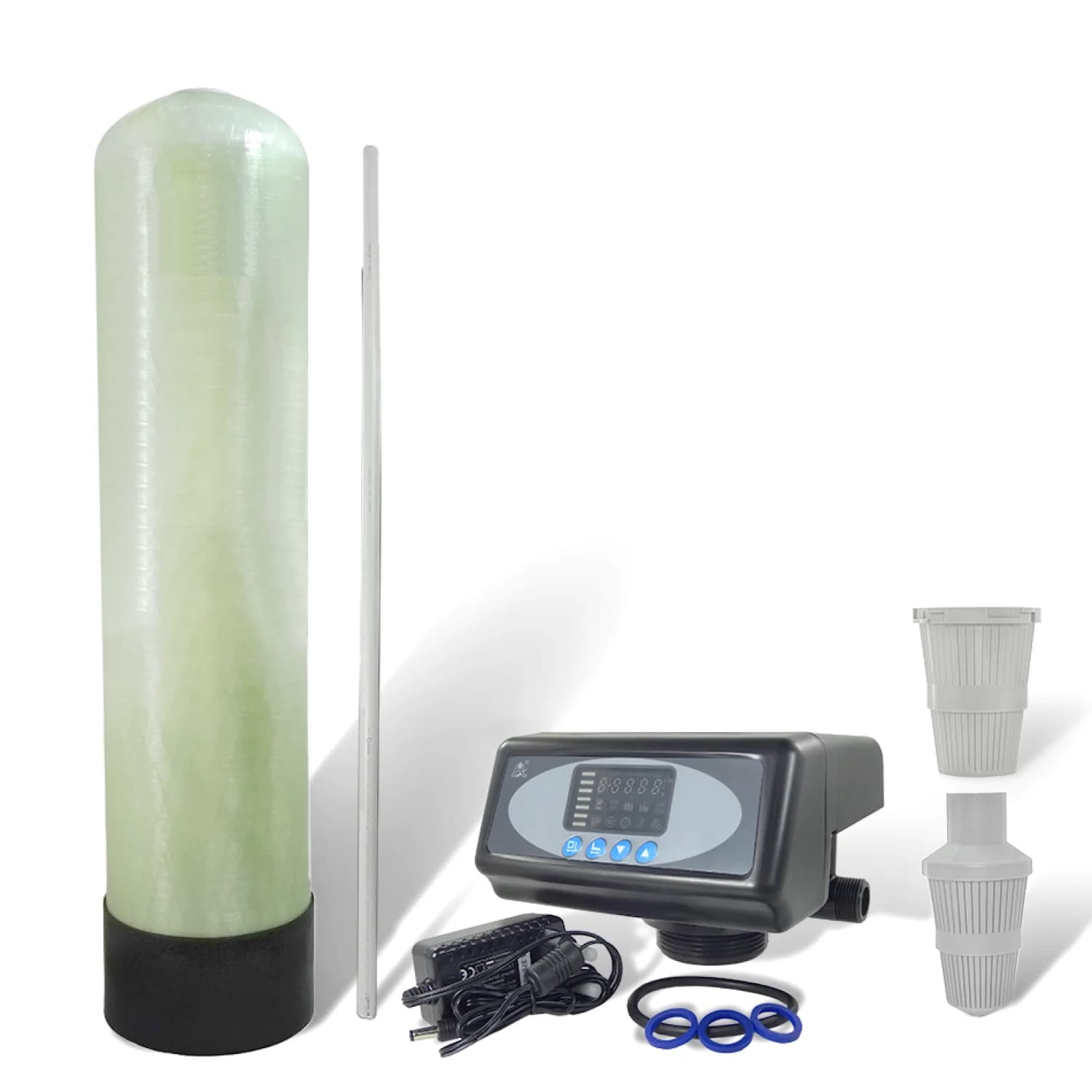
After a filter is installed, the borehole water no longer turns yellow and the iron taste is gone, yet a grey or black film still appears on white sanitary ware. This is what manganese usually looks like when it has passed through a scheme designed for iron. Let us look at why this happens and what you need to know about the water to choose a scheme that removes manganese specifically.
How manganese shows itself
Dissolved manganese does not colour the water: it can run clear from the tap. Problems appear later, when manganese oxidises in the pipes, in the water heater or on the surface of sanitary ware. Even hundredths of a milligram per litre leave visible marks over time.
Typical signs: grey and black stains on ceramics, tiles and shower glass, dark sediment in the storage tank and water heater, water darkening after standing, a metallic or earthy taste. Cartridges darken quickly, and grey streaks remain on laundry after washing.
In a house this is an inconvenience. In a hotel or café it is a matter of reputation: a guest does not know water chemistry, they see stains and draw conclusions about how clean the room is. The first step with such signs is a water analysis — how to order and read one is described in the article on water analysis.
Why manganese is harder than iron
Iron and manganese often occur together and are frequently treated as one problem. Chemically they behave differently.
Ferrous iron is oxidised by atmospheric oxygen quickly: at pH around 7 and above the process takes minutes. Flocs of iron hydroxide form, and the filter retains them. That is why the "aeration plus filter" scheme usually works for iron — it is covered in detail in the article on aeration and iron removal.
Dissolved manganese is oxidised by atmospheric oxygen very slowly at the pH of 6.5–7.5 typical for natural water. A noticeable rate appears only above pH 9, and water with such pH is no longer suitable for household use. So after aeration most of the manganese stays dissolved and passes through the filter: a filter cannot retain what has not yet turned into an insoluble form.
| Parameter | Iron | Manganese |
|---|---|---|
| Oxidation by atmospheric oxygen | minutes at pH 7 and above | very slow while pH is below 9 |
| Does "aeration plus filter" work | usually yes | usually no |
| What speeds up oxidation | aeration, oxidant | catalytic media, oxidant, pH correction |
| How it shows | yellow water, rusty stains | clear water, black stains over time |
| What hinders removal | organics, hydrogen sulphide | low pH, iron and organics in the same water |
Three ways to turn manganese into a precipitate
Every scheme has one task: oxidise dissolved manganese to insoluble manganese dioxide and retain it on the filter media. There are three ways to do this, and they are often combined.
Catalytic media. The grains are coated with a layer of manganese dioxide, and this layer itself speeds up oxidation: dissolved manganese adsorbs onto the surface and is oxidised there. The media usually works at pH 6.5 and above, and its efficiency increases as pH rises to 7.5–8. The layer needs oxygen or an oxidant in the water; otherwise the catalytic surface is gradually exhausted.
Oxidant dosing. Sodium hypochlorite or potassium permanganate oxidise manganese in minutes rather than hours. This requires a dosing station and contact time before the filter — a tank or a pipe section. The dose is calculated from the analysis: the oxidant is also consumed by iron, hydrogen sulphide and organics. Too little oxidant leaves manganese in the water, excess permanganate turns it pink, and excess chlorine requires a carbon stage after the filter.
pH correction. If the raw water is acidic, pH is raised by dosing alkali or by filtration through a correcting media. pH must not be raised without calculation: in hard water this accelerates carbonate precipitation, that is, scale in the water heater and on the media. Before correction, hardness, alkalinity and whatever stands after the filter are checked, especially if reverse osmosis follows.
Why a filter stops removing manganese
If a system is already installed and manganese remains, replacing all the equipment is usually unnecessary. The cause is found first. Typical causes, in order of frequency:
The scheme is designed for iron only. An aeration column and a filter with inert media: iron goes, manganese passes. The solution is catalytic media or an oxidant.
Filtration velocity is too high. For catalytic media the working velocity is usually 5–10 m/h. If the column is sized for average flow, the velocity rises during the morning peak, contact time falls and some manganese slips through. For hotels and houses with several bathrooms the column is sized for peak flow.
The media is poorly backwashed. Oxidised iron and manganese accumulate in the bed. Without an intensive backwash the media cakes, pressure drop grows and channels form in the bed through which water bypasses the grains. Catalytic media usually needs a backwash velocity of 25–35 m/h — often more than a borehole pump delivers. Pump capacity for backwashing is checked before buying the filter.
Low pH. Media that works well at pH 7.5 may remove almost no manganese at pH 6.2.
There is much more iron than manganese. Iron oxidises first and takes up the oxidant and the catalytic surface. With high iron the scheme is made two-stage: iron removal first, then a separate manganese stage.
Manganese is bound to organics. In coloured water with high oxidisability part of the manganese is in complexes that oxidise poorly. A stronger oxidant, a contact tank and sometimes a sorption stage are needed here.
Manganese before reverse osmosis and UV
Manganese is a danger not only to sanitary ware. Oxidising on a reverse osmosis membrane, it forms deposits that reduce output and shorten element life. That is why manganese removal is a mandatory pretreatment stage before a membrane; more on this in the article on membrane pretreatment.
A UV steriliser is also sensitive to manganese and iron: deposits on the quartz sleeve of the lamp reduce the UV dose. UV is installed after the filters, once the water is clear.
A typical sequence for a borehole with iron and manganese looks like this: a mechanical filter, aeration or oxidant dosing if needed, a contact tank, a catalytic media filter on an automatic valve, then softening, UV or reverse osmosis depending on the purpose of the water. The analysis determines which stages you actually need.
What next
Order a water analysis from the point where water enters the house or site, before all filters. To choose a manganese scheme the report must include: manganese, total iron, pH, alkalinity, hardness, permanganate oxidisability, colour, turbidity, ammonium and hydrogen sulphide. If a system is already installed, take a second sample after the filter — it will show exactly what passes through.
Add to the analysis the peak water flow (how many draw-off points run at the same time), pump capacity, whether there is a drain for backwash water and photos of the existing equipment. With this data you can choose the media type and column diameter and see whether an oxidant and pH correction are needed. Filters on automatic valves are collected in the section filtration units, aeration columns in the section aeration units.