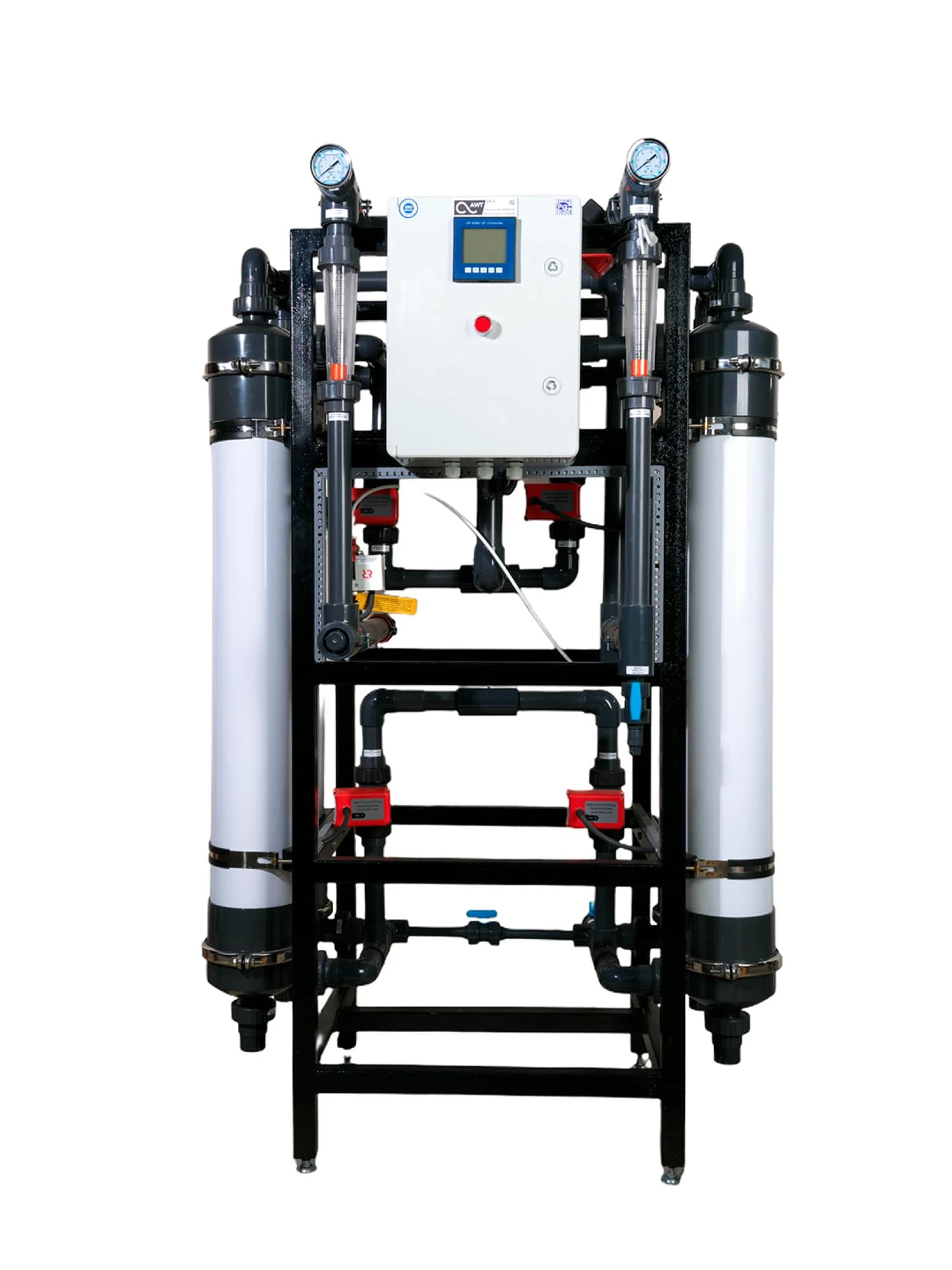
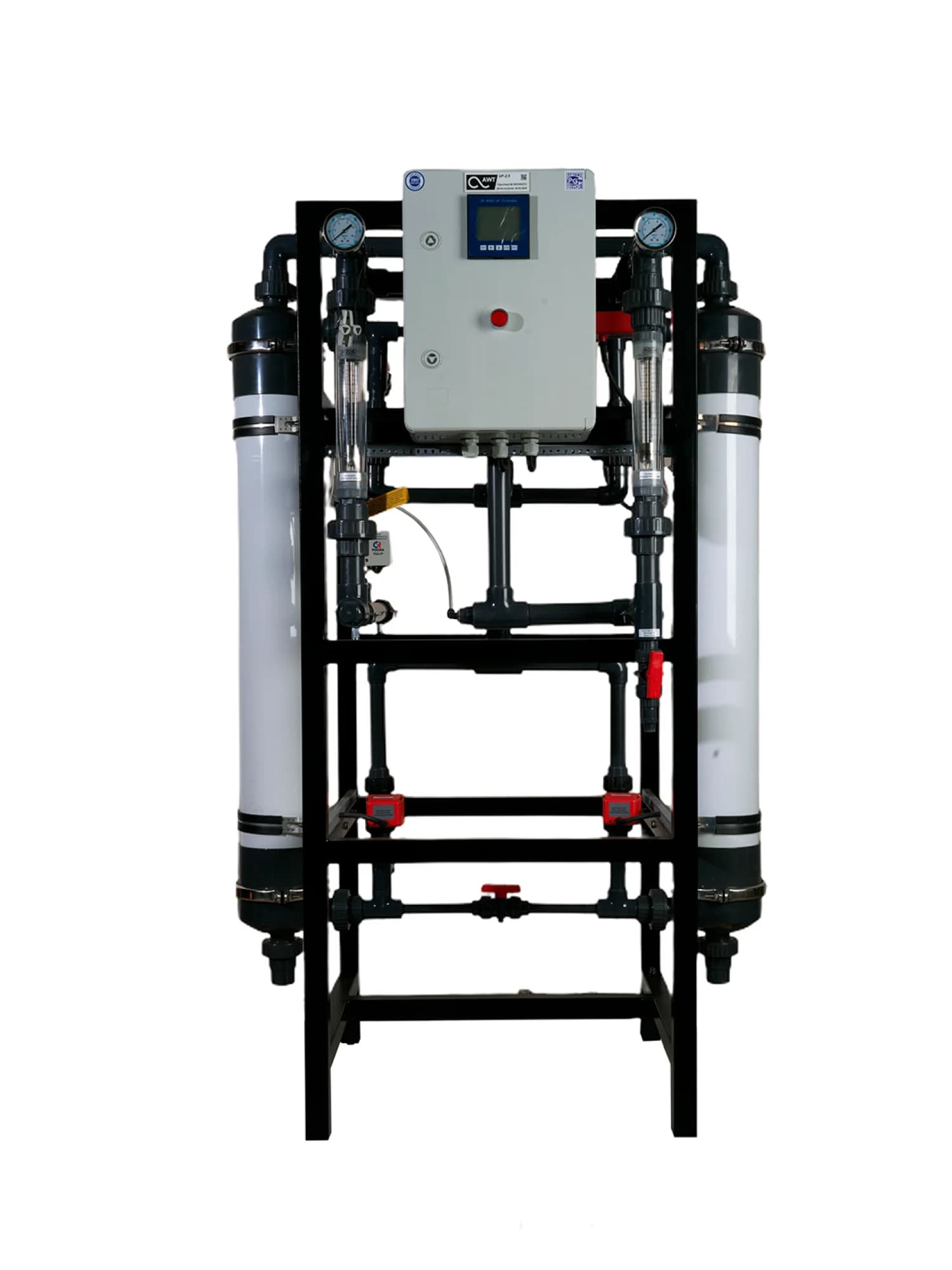
Ultrafiltration on river water: how the membrane gets through a flood

For most of the year a mountain river delivers clear water, and ultrafiltration on it runs quietly. The trouble starts after a downpour or during snowmelt: turbidity rises tens of times within hours, the pressure across the membrane climbs, and output drops exactly when the most water is needed. To prevent this, the operating mode of the unit is designed not for average water but for the worst week of the year.
Why ultrafiltration is used on surface water
Ultrafiltration is membrane separation with pores of the order of hundredths of a micron. The membrane retains suspended solids, colloids, bacteria and most viruses regardless of how turbid the incoming water is. A granular filter works differently: it holds particles within the depth of the media, and with a sudden turbidity spike part of the solids breaks through. A cartridge holds everything, but on river water it clogs within hours and becomes an endless consumable.
That is why for a river, a reservoir or an open intake, ultrafiltration is often chosen as the main barrier. Its filtrate quality is stable. Other values are not: pressure, backwash frequency and output. These are what has to be kept under control when the river changes.
The membrane does not retain dissolved substances. Salts, hardness, dissolved iron and most of the colour pass through it. If they are a problem, other stages are needed, and where the line with reverse osmosis lies is covered in Ultrafiltration versus reverse osmosis.
What happens to the membrane during a turbidity spike
The unit runs in cycles. Filtration lasts several tens of minutes, then a short backwash with filtrate removes the accumulated layer from the membrane surface. The indicator of membrane condition is transmembrane pressure (the pressure difference before and after the membrane). As long as it returns to its starting value after each backwash, the fouling is reversible and the membrane is fine.
During a flood the surface layer builds up faster than the cycle was designed for. Pressure rises more steeply towards the end of filtration, the backwash does not remove the layer completely, and each next cycle starts from a slightly higher point. This is the irreversible part of fouling. Only chemical cleaning removes it, and if even that does not restore the pressure, the membrane loses service life.
Turbidity is not the only cause. River water carries dissolved organics and fine colloids that penetrate the pores and wash out poorly with water. In summer biological fouling adds to them; its signs and remedies are described in Membrane biofouling.
The margin is built in at sizing
The main sizing parameter is the specific flow, or flux: how many litres of filtrate pass through one square metre of membrane per hour. For good groundwater the flux can be set high. For river water with floods it is set noticeably lower, which means more membrane area for the same flow. This is the main turbidity margin, and it cannot be bought later: adding modules to an existing frame is usually harder than choosing a larger unit from the start.
The second margin is the filtrate volume for backwashing. A backwash uses part of the already treated water, usually a few percent of production. During a flood backwashes are more frequent and this share grows. The filtrate tank and the backwash pump must cope with the more frequent mode.
The third margin is room for chemicals. Chemically enhanced backwash (a backwash with added caustic, acid or oxidant) is needed more often during a flood. If the dosing unit is designed for rare cleanings, it becomes the bottleneck.
Temperature is considered separately. Cold water is more viscous, and at the same pressure less of it passes through the membrane: in winter, with water near freezing, the output of the same unit is noticeably lower than in summer. In the mountains snowmelt brings cold water and high turbidity at the same time, so for ultrafiltration the spring flood is usually harder than a summer downpour. The design is based on the minimum water temperature, not the average.
Pretreatment and inline coagulation
Ahead of ultrafiltration there is almost always a fine screen or disc filter: it protects the modules from sand, leaves and sharp particles that damage the fibres. This is a mandatory unit, not an option.
If flood turbidity is moderate, coagulation directly ahead of the membrane helps. A small coagulant dose gathers fine colloids into microflocs. The flocs form a loose layer on the membrane that backwashes off more easily, and less dissolved organic matter passes through. No clarifier is needed, but the dose has to change along with the river quality. The equipment for this is in the dosing stations section.
If after a downpour the river carries clay at hundreds of turbidity units, coagulation ahead of the membrane alone is not enough. Then the bulk of the solids is removed by a separate clarification stage. How to choose between a lamella clarifier and flotation is covered in Turbid river water: lamella clarifier or DAF flotation.
How to tell the mode is right
The mode is checked against several comparable indicators. They are best compared on an ordinary day and during a flood.
| Indicator | Normal water | Flood | What to do if it deviates |
|---|---|---|---|
| Inlet turbidity | low, stable | rises tens of times within hours | switch on or increase coagulation, add a clarification stage if needed |
| Transmembrane pressure at the end of the cycle | barely rises from cycle to cycle | rises noticeably | shorten the filtration cycle, reduce the flux |
| Pressure after backwash | returns to the starting value | does not fully return | run a chemically enhanced backwash |
| Backwash frequency | as designed | more frequent than designed | check the filtrate reserve and backwash pump capacity |
| Filtrate turbidity | low | stays low | rising filtrate turbidity signals a damaged fibre; check integrity |
The last row matters for drinking water. Ultrafiltration protects only while the fibres are intact. An integrity test (applying air under pressure and checking its leakage through the membrane) is carried out on the unit's schedule. Disinfection is still installed after ultrafiltration: it protects the storage tank and the network, where water stands and can be recontaminated. The units are in the UV disinfection section.
The backwash water also has to go somewhere. It is a few percent of the flow with concentrated solids, and after chemical cleaning it carries reagent residues. Its disposal is planned in advance: where to discharge it, and whether neutralisation and holding are needed.
What next
Collect a year of river data, not a single sample. You need turbidity and suspended solids on an ordinary day and after heavy rain, colour, permanganate oxidisability, pH, water temperature in winter and summer. Note how many days a year the water is turbid and how quickly it clears after a downpour. What to order from the laboratory is described in Water analysis.
Then define the hourly and daily flow, the peak demand and the storage tank volume: a reserve of clean water lets you get through a flood without overloading the membrane. With this data, open the ultrafiltration section and choose a unit at a reduced flux, with a membrane area margin for the worst week of the year.