Ultrafiltration vs reverse osmosis: where the line runs
Both are called membrane technologies, and on a diagram they look alike: a housing, a pump, an inlet, a permeate outlet, a concentrate discharge. They differ in exactly one thing — the size of what the membrane will not let through. That one difference governs the water you get, the pressure, the power bill and the price. Here is where the line actually runs.
A different retention threshold means a different result
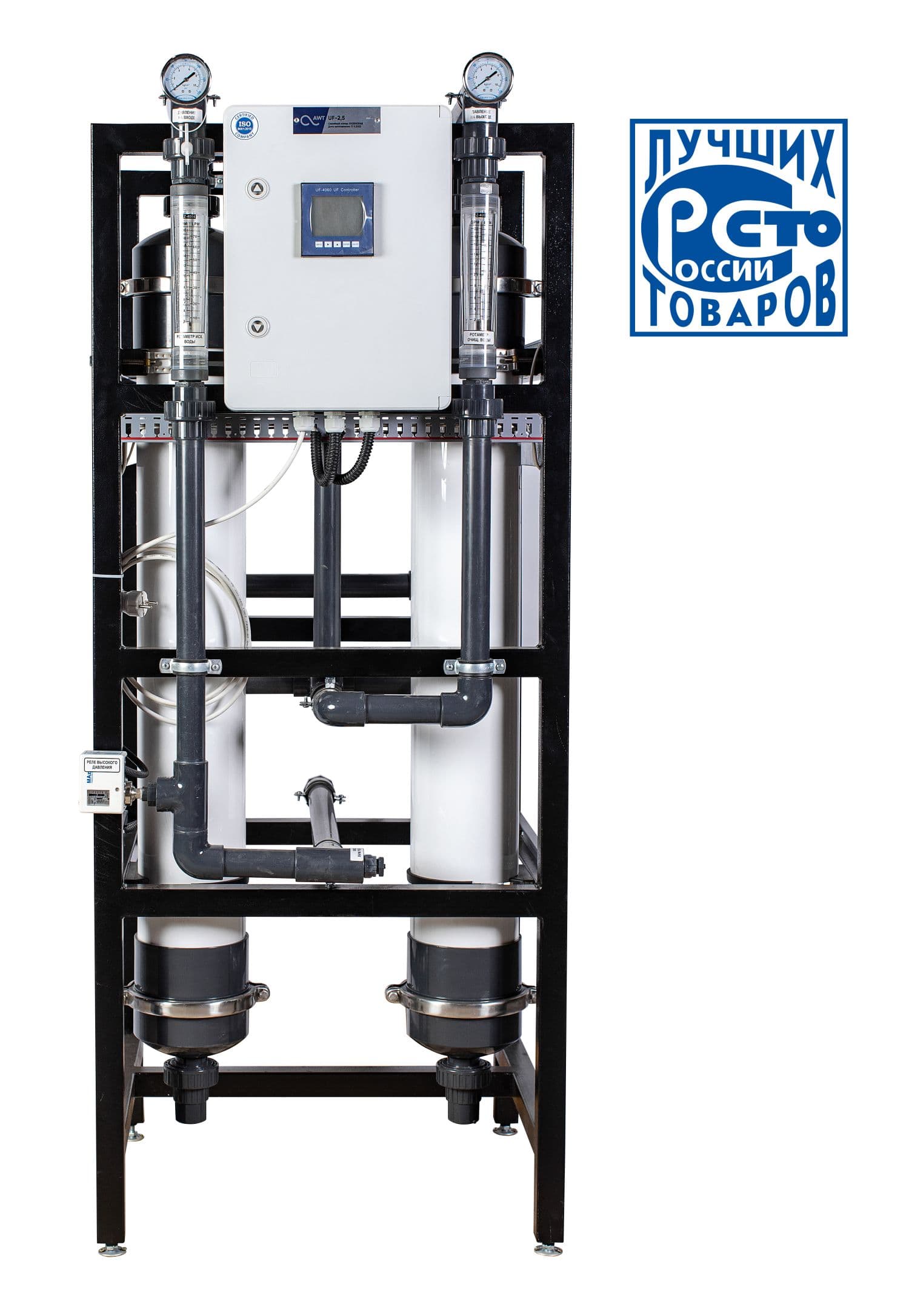
An ultrafiltration membrane is a porous barrier with a filtration fineness of 0.1 to 0.01 µm. Separation runs on a pressure difference: it overcomes the friction and interaction forces between the liquid and the membrane surface, water goes through the pores, and anything larger than a pore stays behind. SWT UF units use PAN hollow-fibre membranes working inside-out: water is fed into the fibre and leaves through its wall.
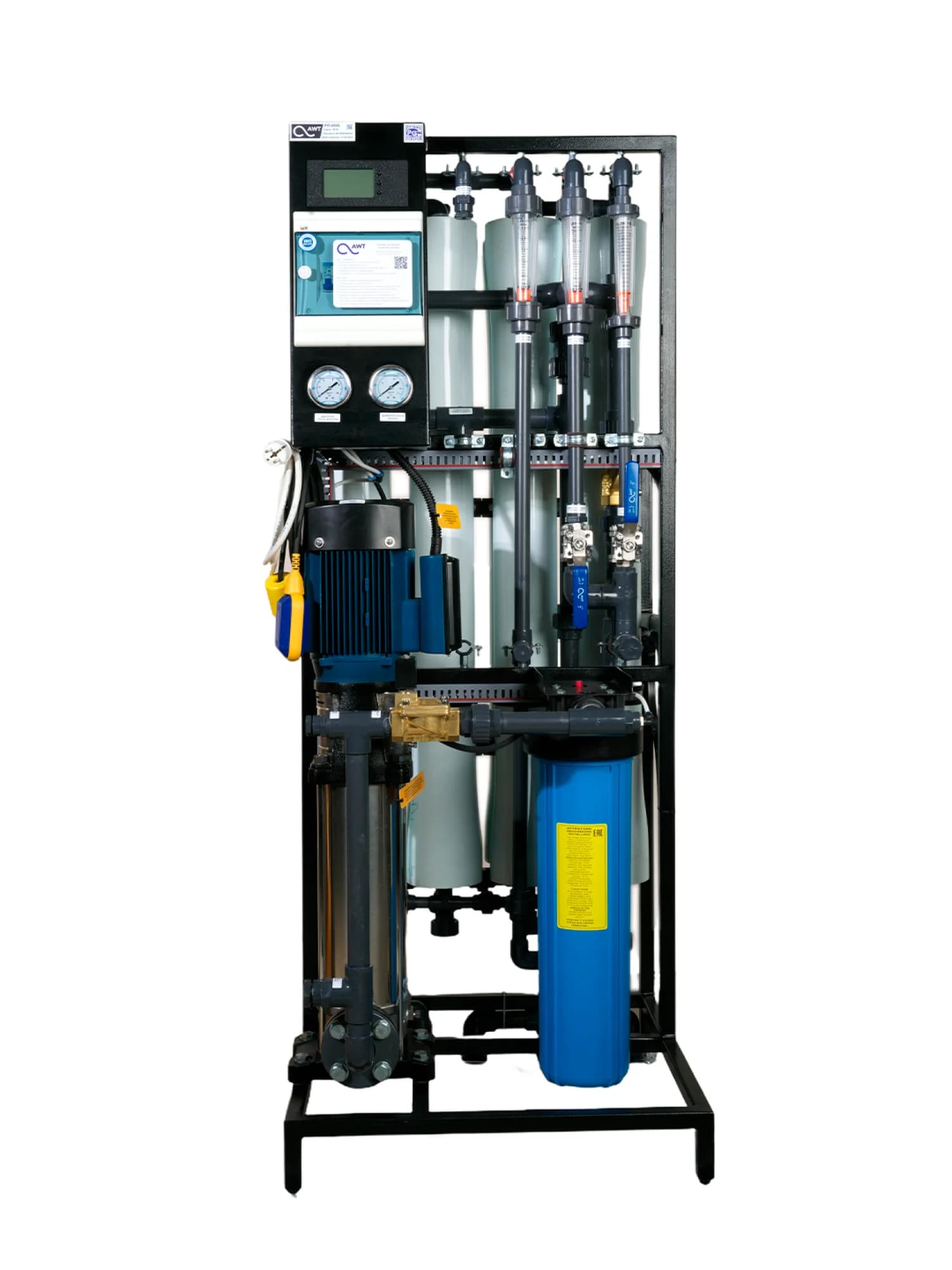
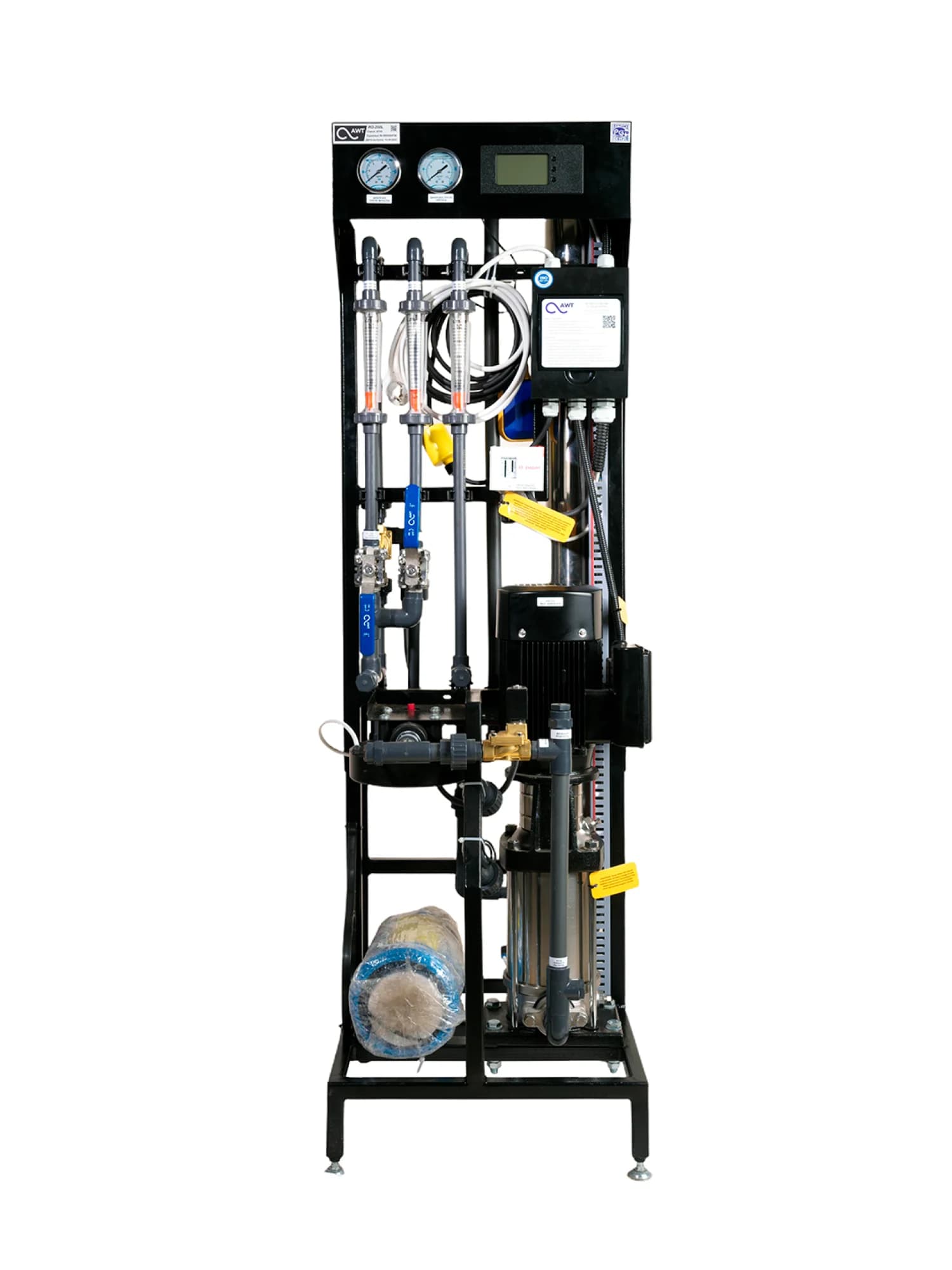
A reverse osmosis membrane has no pores in that sense: it lets water molecules past and holds back dissolved substances down to the level of ions. That is why osmosis lowers total mineralisation and ultrafiltration does not.
This is not a matter of "weaker" and "stronger". They are different jobs.
| Ultrafiltration SWT UF | Reverse osmosis SWT RO | |
|---|---|---|
| What it retains | suspended solids, colloids, organics, fats, insoluble oil products, proteins, large bacteria | dissolved salts, hardness salts, heavy metals, fluorides, nitrates, ammonium, organics, bacteria, viruses |
| Salt composition of the water | stays the same | drops, demineralisation up to 99 % |
| Threshold | 0.1–0.01 µm | the level of dissolved ions |
| Working pressure | tenths of a MPa | from 1.3 MPa upwards depending on salinity |
| Discharge to drain | 10–20 % of the feed water | recovery up to 75 % on fresh water |
What ultrafiltration removes
A UF unit takes out turbidity and colour, removes colloids and organics, holds back large bacteria and leaves the water’s salt composition exactly as it was. In effect it does the work of settling plus microfiltration — two stages that take up floor space and need looking after.
Typical tasks where that is enough:
- ✓Clarifying turbid surface water. A river, a reservoir, a seasonal flood. Turbidity and colour go, and the mineralisation of such water is usually no trouble to begin with.
- ✓A microbiological barrier. Large bacteria are held back mechanically, with no reagent and no irradiation dose.
- ✓Standalone water supply for houses — where the water is acceptable on salts but not on clarity.
- ✓Municipal water treatment and process water preparation.
- ✓Effluent polishing and water recycling — holding back suspended solids, fats and insoluble oil products before the water goes round again.
The SWT UF range runs by capacity from UF-2.5 to UF-60, that is up to 60 m³/h. What grows across it first of all is membrane area: UF-2.5 has two modules totalling 27.4 m², UF-5 four modules at 54.8 m², UF-7.5 also four but at 82.2 m², UF-10 six modules and 100 m². Backwash consumption grows with the area: 0.75 m³/h on UF-7.5 and 1.0 m³/h on UF-10.
The pipework follows the flow. On UF-10 the raw water inlet and the backwash line are both G2, on UF-5 and UF-7.5 G1½, while the outlet is the same right across the range, G1¼. The larger models share the same envelope: 1250×1030×2030 mm for both UF-10 and UF-7.5. The weights are another matter — 160 kg for UF-10 and UF-15, 400 kg for UF-20, 450 kg for UF-30 — and that is worth allowing for when you pick the spot for it.
Where ultrafiltration will not help
Anything dissolved goes straight through an ultrafiltration membrane. The list is short, but it is exactly the list that brings most people to water treatment in the first place:
- ✓Hardness. Calcium and magnesium salts are dissolved, so the scale after UF will be exactly what it was.
- ✓Total dissolved solids. A brackish borehole comes out of ultrafiltration clear and brackish.
- ✓Nitrates, fluorides, ammonium. Dissolved ions, and the retention threshold has no hold on them.
- ✓A salty aftertaste and mineralisation in beverages and food lines.
If the brief sounds like "get the salts out", "demineralise", "bring the mineralisation down", "give me water of constant composition whatever the source" — that is reverse osmosis, and no amount of ultrafiltration fineness will stand in for it.
The reverse holds too. Putting in osmosis to deal with turbidity means paying in pressure and drain water for work a membrane does at tenths of a MPa.
The combination: ultrafiltration ahead of osmosis
The third option is not "or" but "and". Pretreatment ahead of reverse osmosis is listed outright among the typical duties of SWT UF units, and the reason is simple: an osmosis membrane is sensitive to whatever reaches it.
Suspended solids and colloids settle on the surface of the membrane element, permeate flow drops, cleanings come round more often, the interval between them shrinks. Ultrafiltration takes that load off completely: the osmosis stage sees water of constant clarity no matter what the source is doing — a flood, a seasonal bloom, sediment stirred up after a repair in the network.
The economics of such a scheme are counted not in the cost of the stage but in the life of the osmosis membranes and the number of chemical cleanings per year. The dirtier and less predictable the source, the faster ultrafiltration pays for itself.
One important caveat: ultrafiltration covers only the undissolved part of pretreatment. Everything it lets through reaches the osmosis stage unchanged — hardness salts included, and those are quite capable of settling on the membrane from the inside. So "UF plus osmosis" does not do away with the other stages of the train; it takes one specific load, suspended solids and colloids, off them.
How the maintenance differs
The difference in day-to-day running is every bit as marked as the difference in the water.
On ultrafiltration a controller runs the filtration, forward flush and backwash modes. Deposits come off by chemical regeneration, CIP or CEB — acid, alkali and hypochlorite; in those modes a pH range from 2 to 12 is allowed, while the working range is narrower, 3 to 9. Water temperature has to be 5–40 °C. UF-10 works at 0.1 MPa, and above 0.3 MPa the unit locks out automatically. Service life is 10 years and up.
The room has its own requirements: heated, 5–35 °C, humidity no higher than 75 %, and 1000 mm of access for maintenance.
Ultrafiltration concentrate accounts for 10–20 % of the feed flow, and where it falls in that band depends on the quality of the raw water and on what is demanded of the treated water. Osmosis has a figure of its own: the commercial RO-1000L takes 1660 l/h of raw water to deliver 1000 l/h of permeate. Both numbers belong in the water supply design and the drainage design from the start.
What next
The decision is straightforward. Take the water analysis report and read two groups of parameters separately. Turbidity, colour, suspended solids, microbiology — that is ultrafiltration territory. Total dissolved solids, hardness, nitrates — osmosis territory. If both groups are a problem, the scheme will be a two-stage one, with ultrafiltration first.
Then the catalogue: ultrafiltration units cover the range up to 60 m³/h and are sized on flow, standard reverse osmosis units are sized on flow and on the salt content of the raw water. If you do not have an analysis yet, start there: without figures on salts there is nothing to choose between the two membranes on.