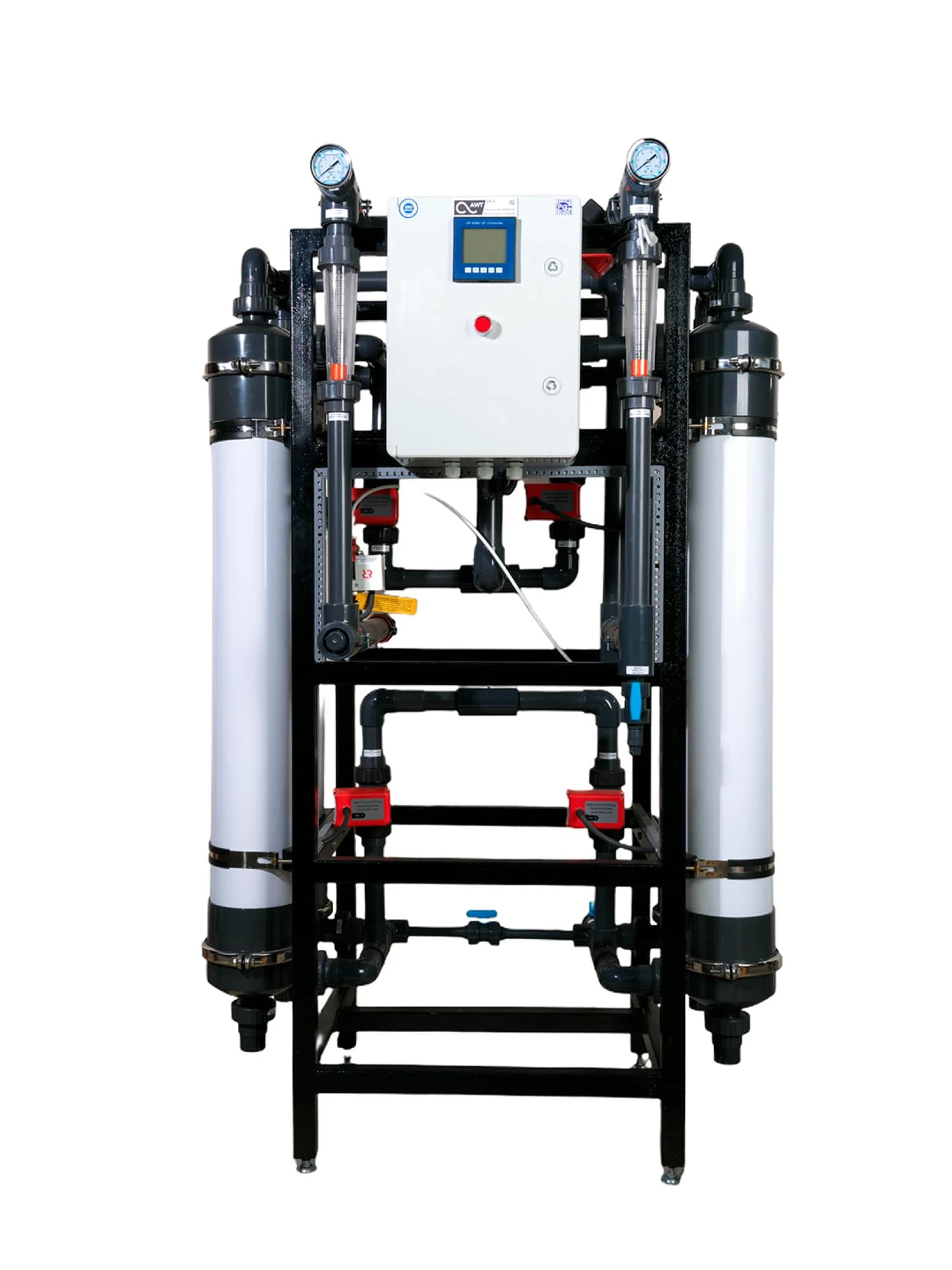
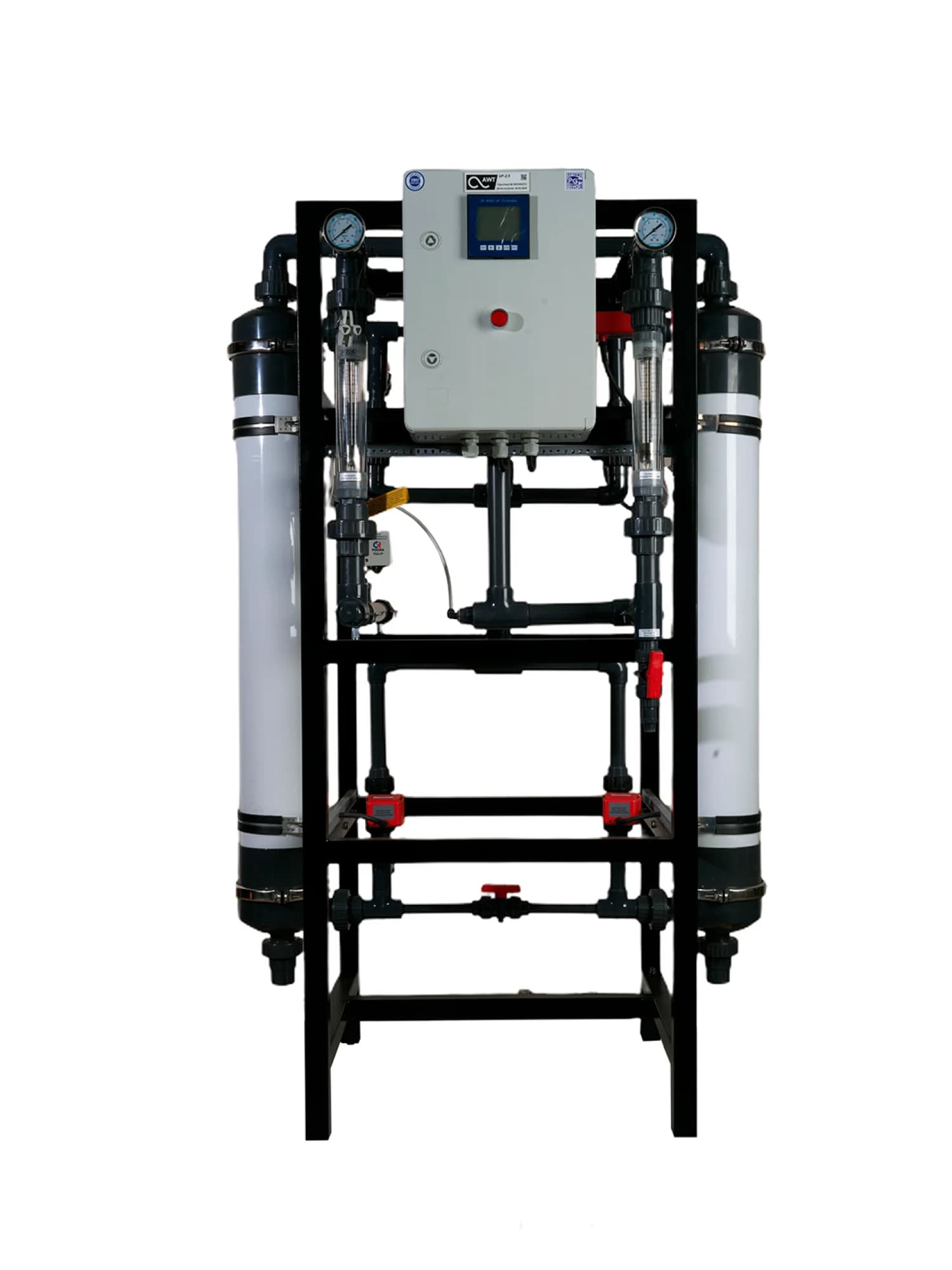
Membrane pretreatment: why reverse osmosis dies in six months
A membrane element is designed for years of service, yet on real sites it is often replaced after six or eight months. The membrane itself is almost never the cause: something reached it that the stage before should have taken out. Here is what actually kills a membrane, which unit answers for what, and how to spot the problem before the element turns into a consumable.
Five reasons a membrane fails early
A reverse osmosis membrane is a dense polyamide layer rolled into a spiral with mesh spacers between the turns. Water is forced through it under pressure and the salts stay behind in the concentrate. There are five ways to kill that structure, and each of them works differently.
Suspended solids block the spacer channels: the pressure drop across the element rises and the water stops using the whole surface, cutting itself a few preferred paths instead. Dissolved iron and manganese oxidise straight onto the membrane and settle as a dense film that no ordinary flush will remove. Free chlorine works differently — it does not block anything, it destroys the polyamide layer itself, and the damage is irreversible: the salt content of the permeate rises and never comes back down.
Colloids and organics build a stubborn slime layer out of particles that the cartridge cannot hold back and a turbidity reading does not show. Last come the hardness salts: by the outlet of the unit the concentrate is several times saltier than the raw water, calcium and magnesium reach their solubility limit and crystallise on the membrane surface — that is scale, not fouling.
Pretreatment deals with the first four mechanisms. The fifth is handled either by pretreatment or by a reagent, and choosing between the two is a separate conversation.
Solids and colloids: what a cartridge takes out and what it does not
A mechanical filter always goes in ahead of the membrane, usually rated at 5 µm. It protects the high-pressure pump more than it protects the membrane, and it is the last line of defence: if it clogs within a week, that is a verdict on everything upstream of it, not a reason to change cartridges more often.
Its limits matter just as much. A 5 µm cartridge holds back no colloids — particles a fraction of a micron across that stay suspended and never settle out. Water that looks perfectly clear can still be hard on a membrane. How hard shows up in the silt density index, SDI: it is measured on a separate test filter with a 0.45 µm membrane, and for polyamide elements the figure is normally kept below 5.
A high SDI is not something cartridges can fix — it takes coagulation with clarification, or ultrafiltration. Fitting a finer cartridge ahead of the membrane in the hope of polishing the water out is pointless: it clogs, and the colloids go through regardless.
Iron, manganese and hydrogen sulphide: the job of a reagent-free filter
This is the most common case on borehole water. Iron in groundwater is dissolved and invisible to the eye until the water meets air. It will oxidise sooner or later in any case — the only question is whether that happens before the membrane or on it.
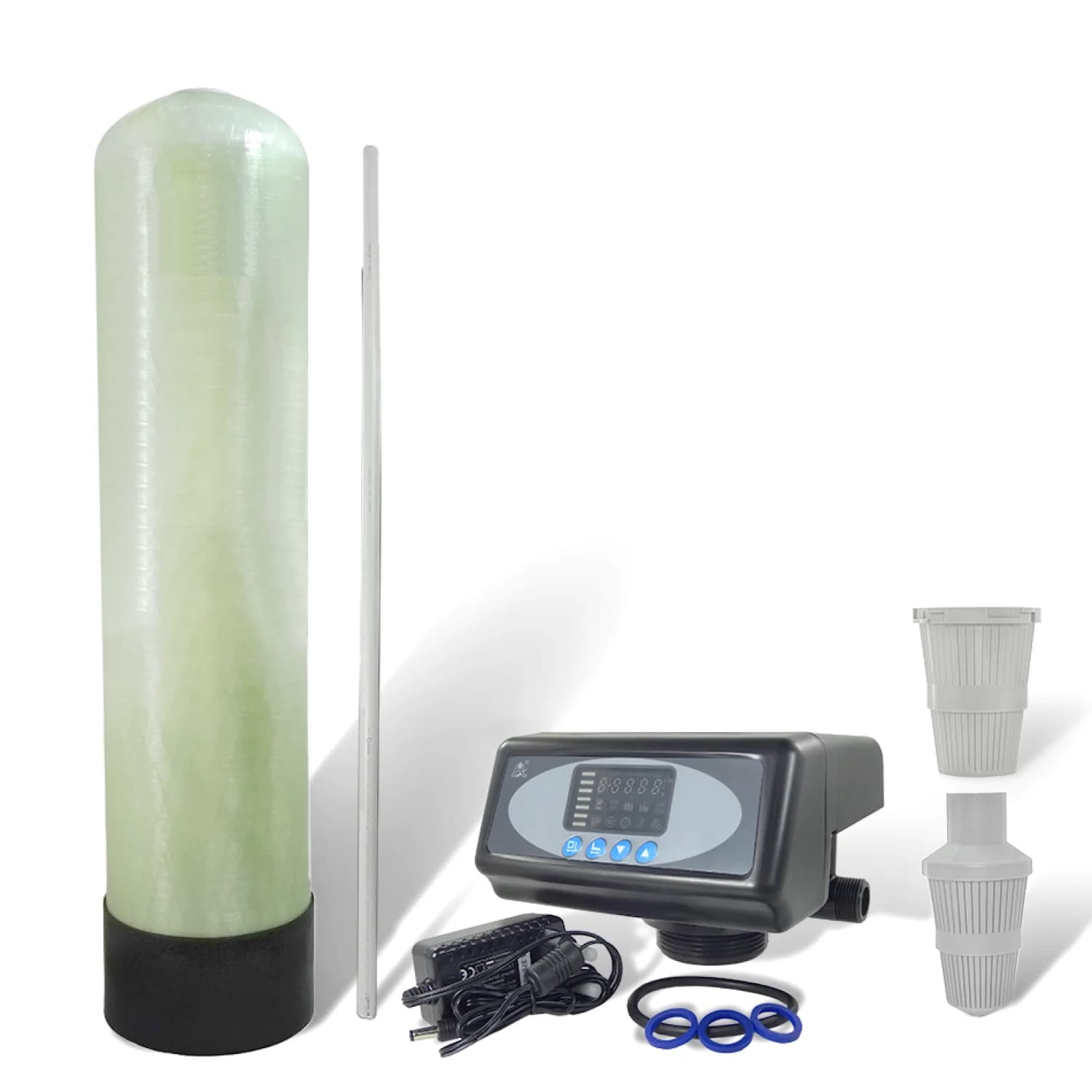
A reagent-free filtration unit takes care of the whole job: oxidation happens on the granular media itself, iron, manganese and hydrogen sulphide turn into an insoluble form, stay in the bed and are flushed to drain during backwash. No reagents are needed, and turbidity and colour leave along with the iron.
Two conditions have to be met, or the stage will not work. The first is water for the backwash: backwashing runs at a flow higher than the service flow, and if the pressure is short, the bed never lifts and never cleans itself. The second is a drain with enough capacity. Those two are exactly what gets overlooked when the layout is drawn.
Such filters are sized by the combined content of iron, manganese and hydrogen sulphide — which sets how often they backwash — and by the peak flow, which sets the tank diameter. In the catalogue of reagent-free units on automatic valves the tanks run from 8×17″ up to large industrial sizes, and the bigger valves on tanks of 24 inches and over have 2 and 3 inch connections and a rated flow of 10 to 50 m³/h.
Hardness salts: softener or antiscalant
Here the road forks. There are two ways to keep hardness salts from scaling the membrane, and they are not equivalent.
An antiscalant is a reagent that stops salts crystallising on the membrane surface. A dosing station meters it into the water ahead of the unit. In its favour: little to invest, little space taken, no wash water going to drain. Against it: the reagent has to be bought again and again, the dose is worked out for one specific water composition and recovery, and the moment dosing stops the protection is gone.
Softening physically strips calcium and magnesium out of the water. An ion exchange unit passes the water through a resin bed, hardness ions swap places with sodium, and once the exchange capacity is spent the controller regenerates the bed with brine. The membrane is then fed water with nothing left in it to precipitate. The same hardware covers neighbouring jobs: pick a different resin and the unit will cut alkalinity, partly demineralise the water, or take out nitrates or boron.
The practical rule is simple. The higher the raw water hardness and the higher the recovery on the unit, the sooner an antiscalant stops being enough. Single-tank softening units cover flows up to 4.5 m³/h on tanks from 8 to 13 inches; the metered valves — F117Q3, F69A3, F63C3 and the other versions marked "with meter" — count the volume actually used, which matters on sites with uneven draw-off.
Free chlorine is dealt with separately — by an activated carbon filter or by dosing a reducing agent. Carbon takes out part of the organics as well, but it has to be replaced, and left standing with no water moving through it, it turns into a breeding ground for bacteria in its own right.
Signs that pretreatment is no longer keeping up
The membrane gives warning well in advance, provided the readings are taken and normalised to the same conditions — temperature, pressure and raw water salt content. Comparing bare numbers from different days is pointless: cold water on its own yields less permeate.
- ✓The pressure drop across the stage rises at unchanged flow — the channels are fouling mechanically, so look for suspended solids and biofouling.
- ✓Permeate output falls while its salt content holds steady — the surface is blanketed with deposits.
- ✓Permeate salt content rises while output holds or even goes up — the polyamide layer is damaged, typically by chlorine.
- ✓Cleaning brings the figures back, but each time they hold for less time — that is pretreatment failing, not the membrane wearing out.
- ✓The mechanical cartridge clogs noticeably faster than it used to — something upstream has changed: the borehole has moved to another aquifer, a filter has failed, the dosing has drifted off setting.
- ✓Deposits on a removed element read like a diagnosis — rust-coloured is iron, white and dense is hardness scale, slimy is organics and biology.
What next
To design pretreatment you need a full laboratory report on the raw water: hardness, total and dissolved iron, manganese, hydrogen sulphide, turbidity, permanganate index, salt content, and residual chlorine if the water comes off the municipal mains. And separately: the peak and daily flow, and the permeate quality the process calls for.
With those figures the scheme falls into order: mechanical filtration first, then reagent-free removal of iron and manganese, then softening or antiscalant dosing, and only then the RO unit. If you have no analysis yet, start there: the membrane is chosen last, and every mistake made in the stages ahead of it will reach it sooner or later.