Membrane biofouling: how to tell it from scale and how to deal with it
Of all the ways a membrane can foul, biofouling is the most troublesome. Scale can be dissolved with acid and suspended solids caught by a filter, but bacteria multiply right inside the unit, and a few surviving cells are enough for the film to regrow after cleaning. Let us look at how biofouling develops, how it is told apart from other fouling and what actually works against it.
How biofilm forms on a membrane
Bacteria are present in almost any water that has been through conventional treatment. Once inside a membrane unit, some cells attach to the surface of the membrane and the feed spacer. Having attached, they start secreting extracellular polymeric substances — a sticky matrix of polysaccharides and proteins. It holds the cells in place, protects them and captures particles and organic matter from the water.
The film feeds on dissolved organic matter in the feed water. The membrane acts as a concentrator: organics and nutrients build up at its surface, so bacteria get more food there than in the bulk flow. That is why even water with a modest organic content can sustain a film if it contains easily biodegradable compounds.
In spiral-wound reverse osmosis elements the film most often starts at the inlet end of the first element, where food is most plentiful and flow velocity is highest. In hollow-fibre ultrafiltration modules it covers the fibre surface and partly penetrates the pores.
How it is recognised
A membrane unit reports fouling through three values: output, pressure drop and permeate salinity. They can only be compared after normalisation to the same conditions — temperature, pressure and feed water composition. Different foulants show different patterns:
| foulant | where it appears | what rises or falls | how it is removed |
|---|---|---|---|
| Biofouling | first stage, inlet elements | fast rise in pressure drop, falling output | alkaline cleaning with detergent, then biocide |
| Carbonate scale | last stage, outlet elements | falling output, rising permeate salinity | acid cleaning |
| Iron and manganese | first stage | falling output, rust-coloured or dark deposit | acid cleaning with a reducing agent |
| Colloids and suspended solids | first stage | rising pressure drop | alkaline cleaning |
Biofouling has two characteristic signs. First, pressure drop across the first stage rises faster than output falls, because the film clogs the spacer channels. Second, after cleaning the values recover but then deteriorate faster each time: the film has not been removed completely and regrows from the remaining cells.
The definitive answer comes from opening an element — an autopsy. The removed element is cut open, the surface is inspected and the deposits are analysed. Biofilm feels slippery and slimy and often smells; scale is hard and crystalline. On an operating unit, feed water monitoring also helps: total bacterial count, dissolved organic carbon and the growth rate of bacteria in a sample.
Why it is hard to remove
The biofilm matrix shields the cells from cleaning chemicals. A chemical first has to loosen the matrix and only then reaches the cells. Acid cleaning, effective against scale, therefore has almost no effect on biofilm and sometimes makes it denser.
The second limitation is the membrane itself. The polyamide layer of reverse osmosis membranes does not tolerate free chlorine: the oxidant destroys it irreversibly and permeate salinity rises. In other words, the most familiar disinfectant is ruled out for this membrane. Ultrafiltration membranes made of PVDF and a number of other polymers are chlorine-resistant, and chlorine-based cleaning is a standard procedure for them.
How a cleaning sequence is built
Cleaning against biofilm follows a set order, and the order matters.
First stage — alkaline cleaning with a detergent. A high-pH solution loosens and dissolves the organic matrix. Temperature and pH are chosen within the limits allowed for the specific membrane: a higher temperature speeds up cleaning, but every element has its own limit.
Second stage — a non-oxidising biocide. For polyamide membranes, biocides compatible with the material are used. They kill the cells that survive the alkaline stage.
Third stage — acid cleaning, after rather than before. If scale is present as well, it is removed from a surface already cleared of organics.
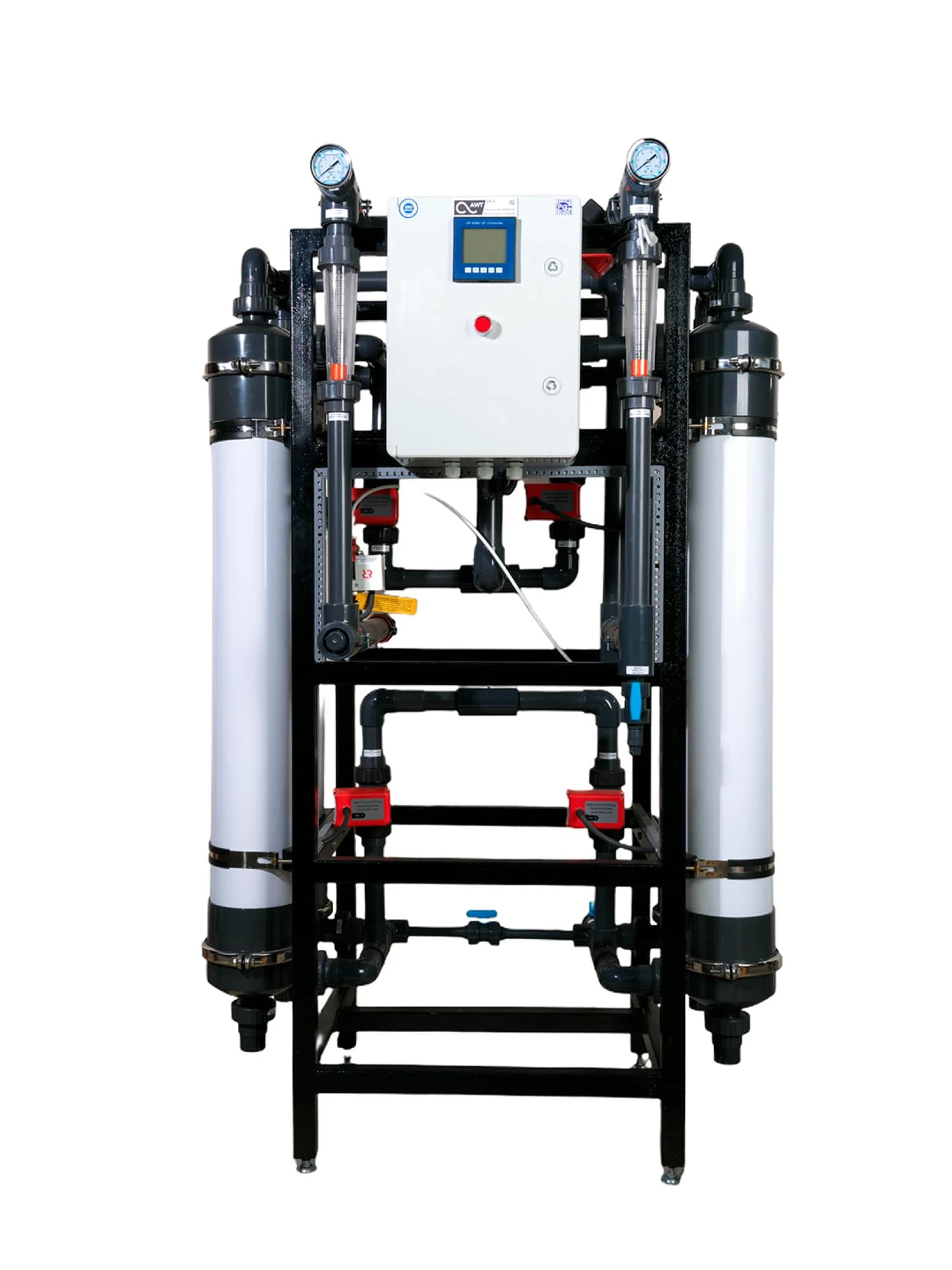
Ultrafiltration adds a tool of its own to these cleanings. Modules are backwashed with filtrate regularly, every few tens of minutes, and several times a day with a chemically enhanced backwash: caustic with an oxidant against organics and biofilm, acid against mineral deposits. This stops the film from taking hold and postpones a full cleaning by weeks. Its frequency and dose are set by the rise in transmembrane pressure between cycles.
Cleaning is started on time, not when the unit has already stopped. The usual guide is a drop in normalised output or a rise in normalised pressure drop of about 10–15 % from the initial value. A heavily fouled element cleans less well, and part of its output does not come back.
How to prevent regrowth
Cleaning treats the consequence. To keep the film from returning, three lines of work are used.
- ✓Reduce the food supply. Coagulation with filtration, activated carbon or ultrafiltration upstream of reverse osmosis removes part of the organics and almost all bacteria. Ultrafiltration gives the most stable water for the downstream membrane.
- ✓Reduce the number of incoming bacteria. If the feed water is chlorinated, the chlorine is removed before the reverse osmosis unit with carbon or a reducing agent — but the water after that point is then unprotected, and the carbon itself can become a breeding ground for bacteria. The dechlorination stage is therefore placed as close to the membrane as possible and maintained on schedule.
- ✓Do not let water stand. For shutdowns longer than a day, the unit is flushed with permeate and preserved with a solution compatible with the membrane. Stagnant water in the unit is a direct route to fouling.
Also worth mentioning are periodic biocide doses introduced into the feed water on a schedule by a dosing station, and an operating mode in which the unit is not stopped for long but switched to short permeate flushes instead.
What next
If you suspect biofouling, collect the unit's operating log for the past few months: output, pressure before and after each stage, permeate salinity, water temperature. Normalise the data to the same conditions and see at which stage and in which value the deterioration shows first. In parallel, order a feed water analysis for total bacterial count and dissolved organic matter.
This data shows what is missing: a cleaning regime, a pretreatment stage or protection against stagnation. If pretreatment is not enough for stable reverse osmosis operation, consider ultrafiltration as a stage ahead of reverse osmosis. Membrane fouling of other kinds is covered in the article on membrane pretreatment.