Hotel water treatment: morning peak, boiler scale, shower-glass film
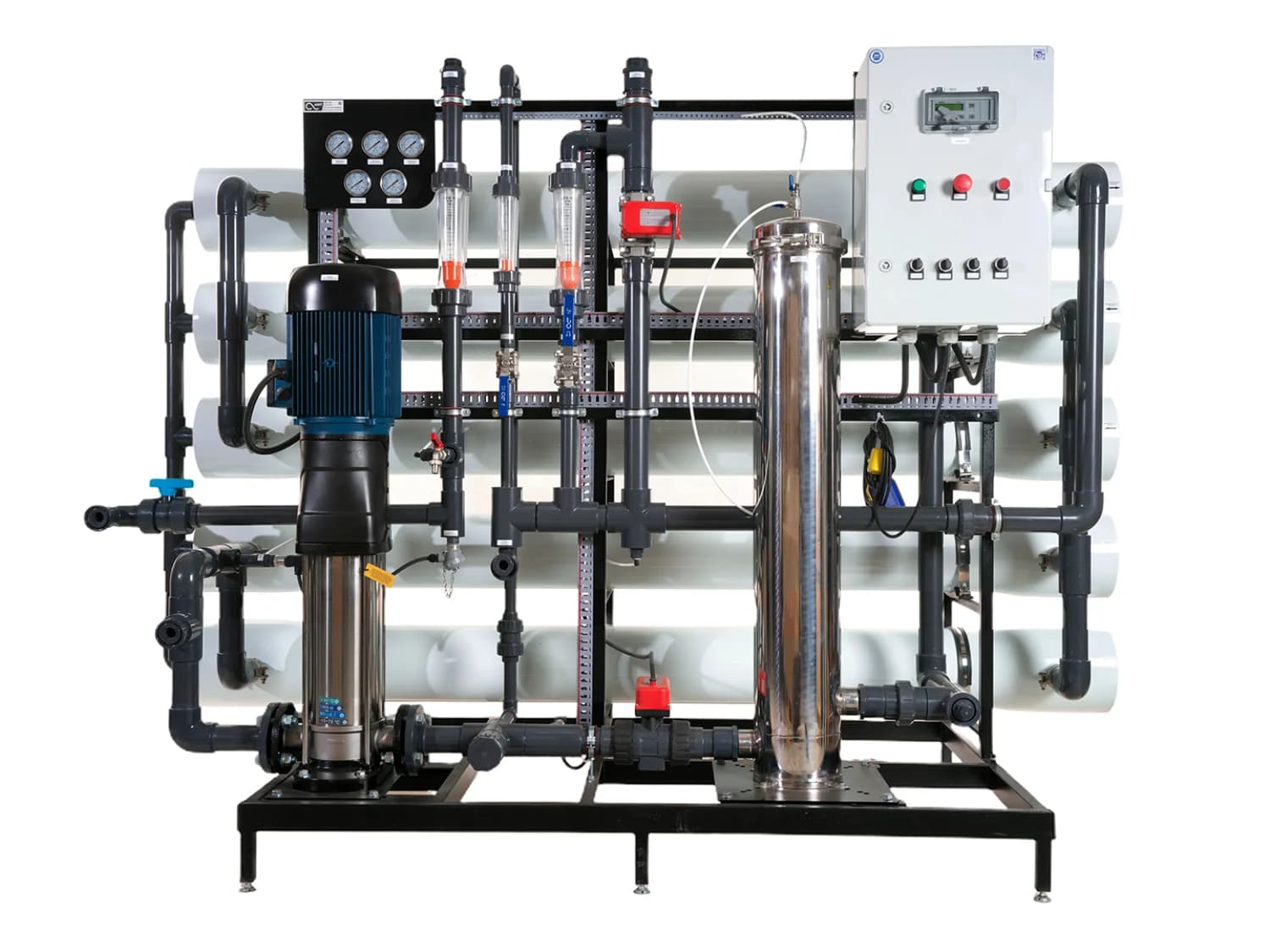
Water in a hotel gets noticed in two situations: when a guest's review mentions white streaks on the shower glass, and when accounts bring in a higher gas bill. Both complaints usually start at the same point — the cold water inlet. Here is what to measure in a hotel and which figures equipment is sized on, so that it does not give up on the first morning of the high season.
A hotel lives on peaks, not averages
Water use in a hotel comes in bursts. Between seven and nine in the morning the showers in the rooms run almost simultaneously, joined by the kitchen at breakfast and the laundry starting up. During the day consumption drops to background levels; in the evening it gives a second, gentler rise.
The average daily flow is almost useless here. It smears those two morning hours across the whole day and produces a figure that sizes the equipment for conditions that arrive at night. A unit sized on the average will, at peak, either choke the pressure or push water through the media too fast — some ions will fail to exchange, and hard water will reach the rooms exactly at the hour when they are fullest.
So a hotel needs two figures worked out separately: the peak hourly flow and the daily volume. The first sets the vessel diameter and the valve throughput, the second the media volume and the run length between regenerations.
You can see where the size classes divide in the catalogue. Vessels from 8 to 13 inches come with Runxin valves, 3/4 and 1 inch connections and a capacity of up to 4.5 m³/h — that is a guest house or a small hotel. Above them come 14×65″, 16×65″ and 18×65″ vessels and larger, up to 63×86″ with F112A3 and F96A3 valves: at that size the flow is no longer that of twenty-odd rooms.
Scale in the boiler is a line in the energy bill
Hardness comes from dissolved calcium and magnesium salts. When heated, they settle on the walls as a dense layer that conducts heat noticeably worse than metal. The mechanics from there are simple: the boiler heats scale instead of water, the burner runs longer for the same volume of hot water, and the gas or electricity bill grows month by month for no visible reason.
A hotel has more heaters than you would think. Domestic hot water boilers, heat exchangers, the dishwasher in the kitchen and in the bar, washing machines and the steam generator in the laundry, ironing equipment, kettles in the rooms. Scale settles in all of them, but they are serviced on different schedules, so the problem is first noticed where the unit is smallest: a dishwasher heating element failing at breakfast.
The hotel sees the second effect of hardness through its guests' eyes. White deposits on taps, shower heads and shower glass do not wipe off, a glass comes out of the wash streaked, towels come back stiff from the laundry. Housekeeping compensates with time and chemicals: detergent consumption in hard water is higher, because part of it goes on binding salts rather than on cleaning.
What the guest smells and tastes
The smell of chlorine in the shower and the taste of tap water are a separate category of complaint, and a softener does not remove them. Other stages are responsible for taste and odour: carbon media takes out free chlorine and organics, mechanical prefiltration takes out turbidity and suspended solids that make the water in a glass look cloudy against the light.
The drinking line in a hotel is usually much narrower than the main one. Coffee at breakfast, ice in the bar, water coolers in the lobby, water in carafes — where taste decides everything, reverse osmosis is installed: it removes the salt background entirely, and it does not require a unit for the whole hotel. The entry-level SWT RO-1/8040 delivers 1 m³/h; for a large kitchen and bar the choice is SWT RO-5/8040 with a 4 kW pump.
Low occupancy, stagnation and disinfection
The off-season creates the opposite problem to the peak. Half the floors are closed, water stands in dead-end branches for days, and circulation in the hot water loop does not reach everywhere. Standing warm water is a medium where microbiology multiplies readily, and the first guest after the idle period gets it in the shower.
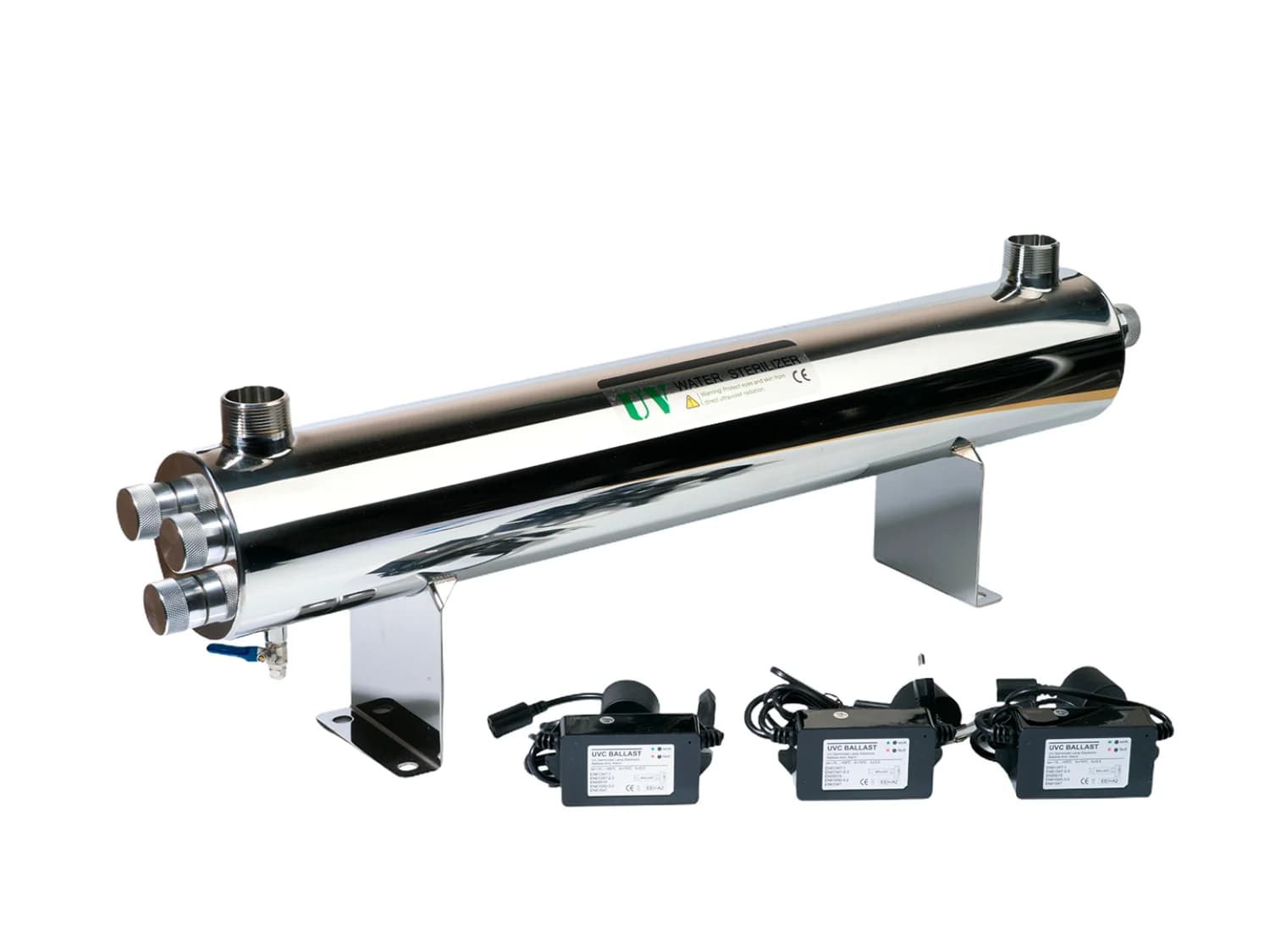
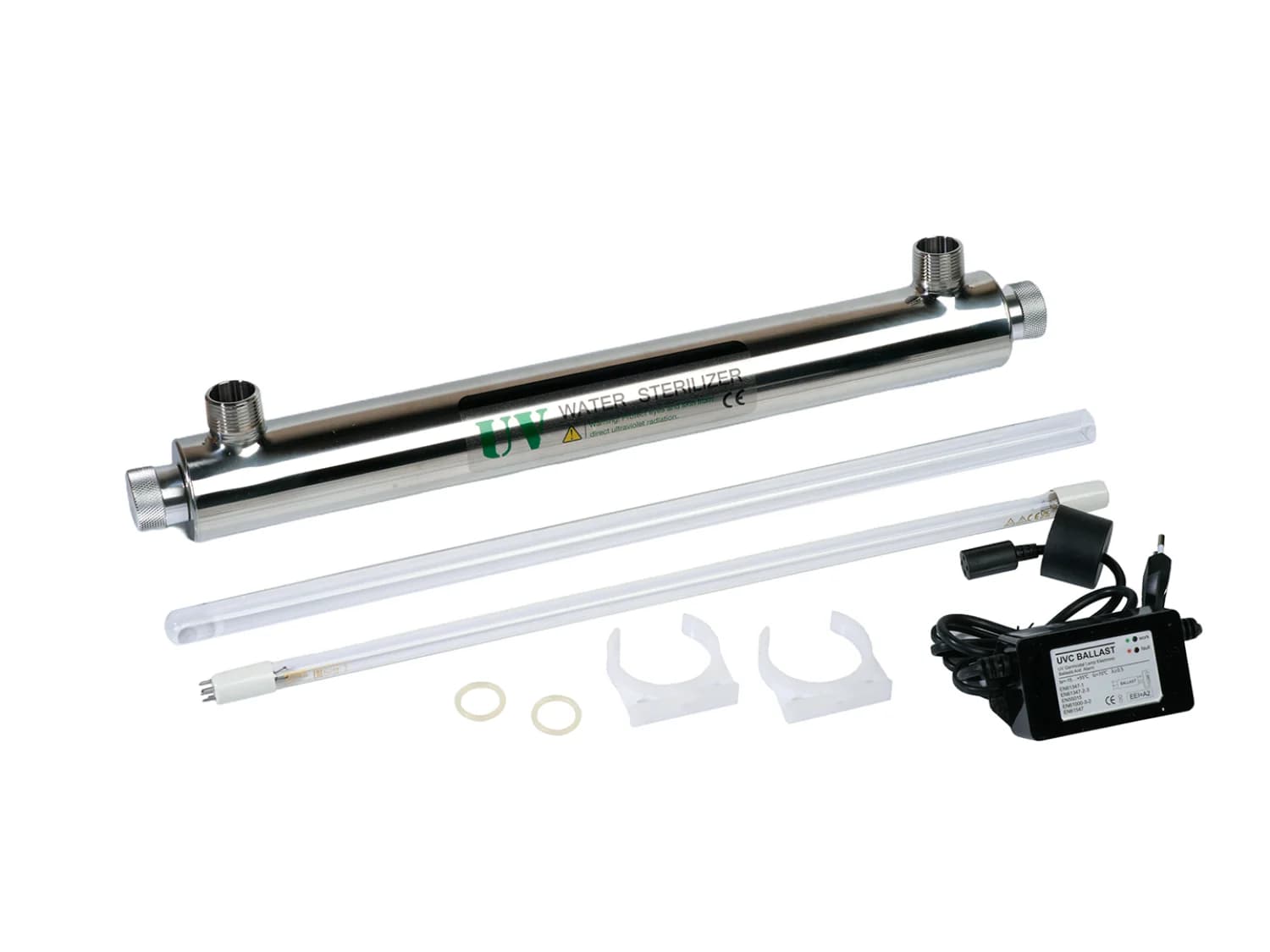
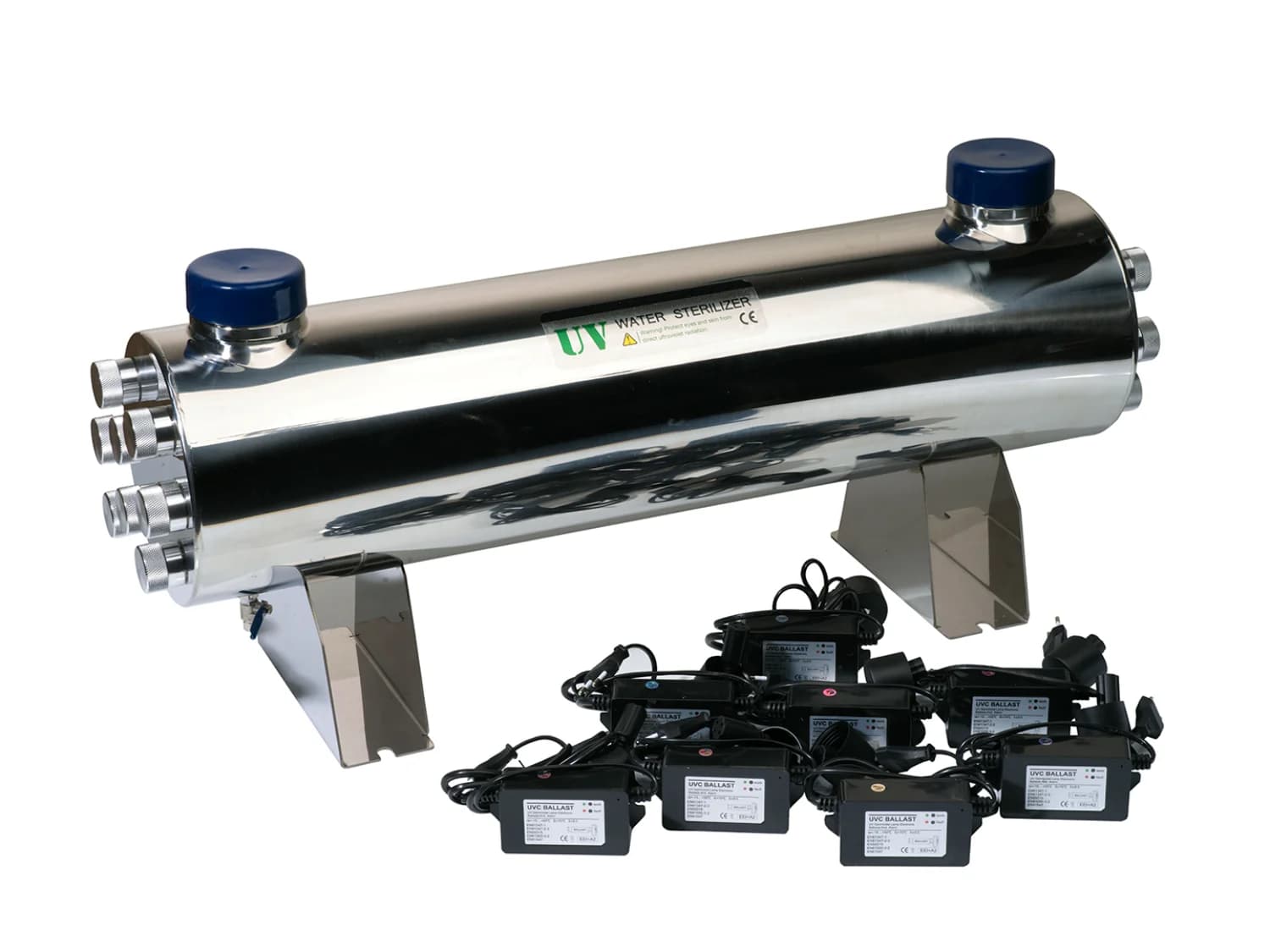
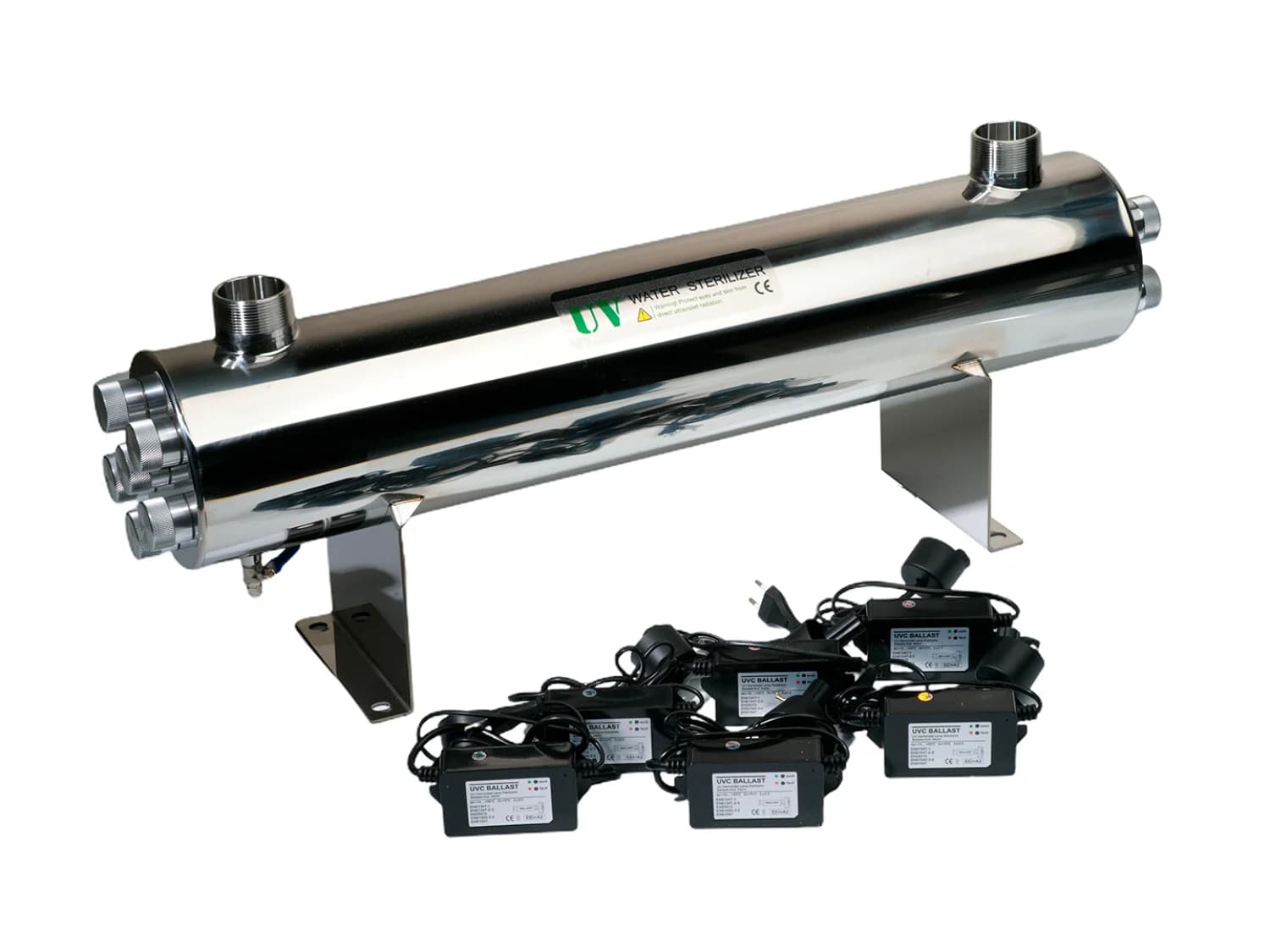
This changes the requirements for ultraviolet disinfection. UV works only on flow: the lamp disinfects the water passing through it and does not protect the pipe downstream. For a hotel the construction of the emitter itself matters — the BAT23 versions carry a low-pressure mercury lamp with a low heating temperature, and such units are used in systems with small flows, including ones with periods of short stagnation. The AAT23 and MAT23 versions carry amalgam lamps with a service life of 12,000–16,000 h and UV intensity monitoring, and MAT23 also has a chemical cleaning unit with an output to the process control system.
Sizing by flow here does not come down to a single figure. UV capacity depends on water transmittance: DUV-1A120-N BAT23 at T=90 % treats 10 m³/h, at T=85 % — 8 m³/h, and on drinking water at T=70 % — 5.8 m³/h. Turbid water halves the capacity, so a mechanical stage ahead of the lamp is mandatory. The range runs from DUV-1-21-N BAT23 at 2.1 m³/h and 24 W to DUV-1A350-N AAT23 at 30 m³/h.
Seasonality also affects softener regeneration. A timer valve regenerates after a set number of days regardless of whether the hotel had a hundred guests or three — in the off-season it burns salt for nothing, and in August it cannot keep up with the load. A meter valve counts the volume actually passed, and for a site with seasonal occupancy that is the only workable option. Almost the entire Runxin range in the catalogue comes with a meter.
Consumers inside the hotel and their requirements
| Consumer | What gets in the way | Stage |
|---|---|---|
| Showers in the rooms | hardness, film on glass and shower heads, chlorine smell | softening, carbon |
| Hot water boilers and heat exchangers | scale, rising fuel consumption | softening |
| Laundry | hardness, excess detergent, stiff towels | softening with margin on the peak |
| Dishwasher and bar | streaks on glassware, heating element failures | softening, reverse osmosis for ice and coffee |
| Kitchen and coffee at breakfast | salt background, aftertaste | reverse osmosis |
| Hot water loop when idle | stagnation, microbiology | UV on flow, mechanical stage before it |
The laundry and the kitchen deserve a separate line in the calculation. Both come on in a surge, and both run in the same hours as the morning shower peak — they add to it rather than spreading across the day. If the laundry is in-house rather than outsourced, its flow is calculated separately and added to the peak, otherwise the unit will turn out undersized exactly in the high season.
What next
Sizing needs four things: an analysis report for the water at the inlet (hardness, iron, turbidity, total dissolved solids), the number of rooms and beds, the peak hourly flow in the morning hours, and a list of your own consumers — laundry, kitchen, pool. Note separately whether an interruption in the supply of softened water at night is acceptable: if the hotel runs round the clock, the scheme is built from two vessels so that regenerating one does not stop the supply.
With these figures it makes sense to look at industrial water treatment — ion exchange units, ultrafiltration, reverse osmosis and UV in one section. If you do not have a water analysis yet, start with that: sizing by feel costs more in a hotel than in a private house, because the mistake is seen not by the owner but by a hundred guests at once.