Water at a winery: washing, the seasonal peak and protecting the wine

At a winery water hardly ever ends up in the bottle — it washes. Tanks, barrels, hoses, pumps, the press, the bottling line, returnable containers: what stays on the vessel wall and on the glass after the rinse depends on what is dissolved in that water. Here is what a winery's water treatment is made of, and why average annual flow is the wrong basis for sizing it.
All the water at a winery is wash water
A winery has no process water consumption in the usual sense: the must comes from the grapes. What it does have is a long list of washing operations, and each one asks something different of the water.
| Draw-off point | What matters | Typical stage |
|---|---|---|
| Tank washing, CIP loop | hardness | softening |
| Final rinse of bottles and returnable containers | dissolved solids | reverse osmosis |
| Barrels, qvevri, hoses, tools | microbiology, absence of chlorine | ultrafiltration, UV |
| Water for solutions and yeast rehydration | mineral content, absence of chlorine | reverse osmosis, UV |
| Boiler and steam generator feedwater | hardness | softening |
| Make-up for the fermentation cooling loop | hardness, suspended solids | softening, mechanical filtration |
The table shows the sizing principle: floors, hoses and vessel washing set the volume of draw-off, while the two or three points where water touches the product or the glass set the quality. Treating all the water on site to final-rinse quality is expensive and pointless; better to split the loops and polish locally where it is needed.
Hardness and CIP: one wash programme, different results
CIP is cleaning by circulation around a closed loop, without dismantling the equipment. The caustic stage removes organics and tartrates, the acid stage removes mineral deposits, with rinses in between. Hard water gets in the way at every step.
- ✓Part of the caustic goes on binding calcium and magnesium out of the water itself, so less active agent reaches the surface — and the programme gets "strengthened" with more dose and more time instead of the water being fixed.
- ✓Calcium out of the water deposits on the walls along with the tartrates. The layer of tartar grows denser and grips harder, and microflora survives underneath it.
- ✓Rinse with hard water and the stainless steel is left with a whitish bloom that reads as "badly washed" even though the wash did its job.
- ✓On a bottle, hardness salts dry into spots and streaks. That is a cosmetic reject already, and it shows on dark glass no less than on light.
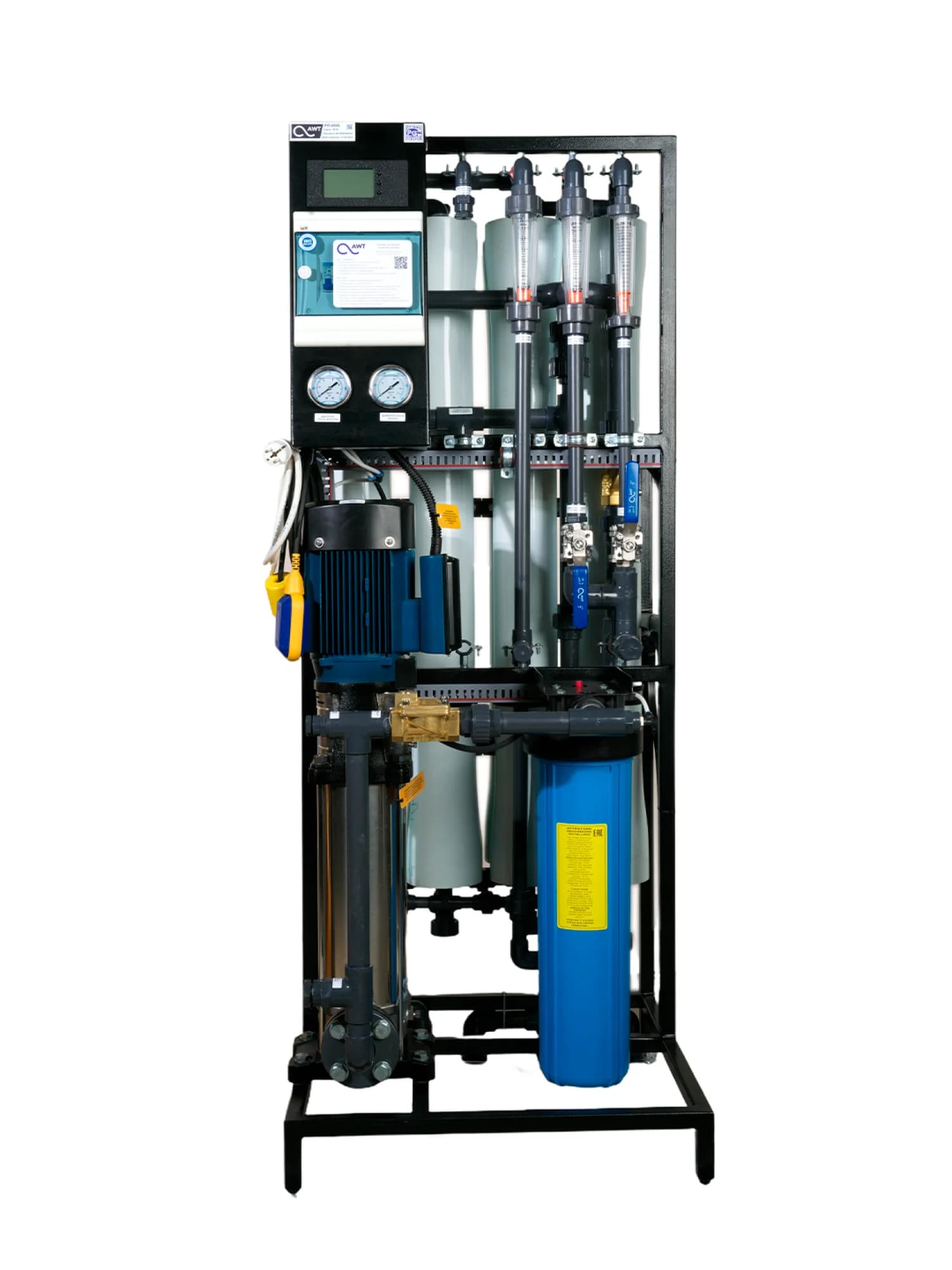
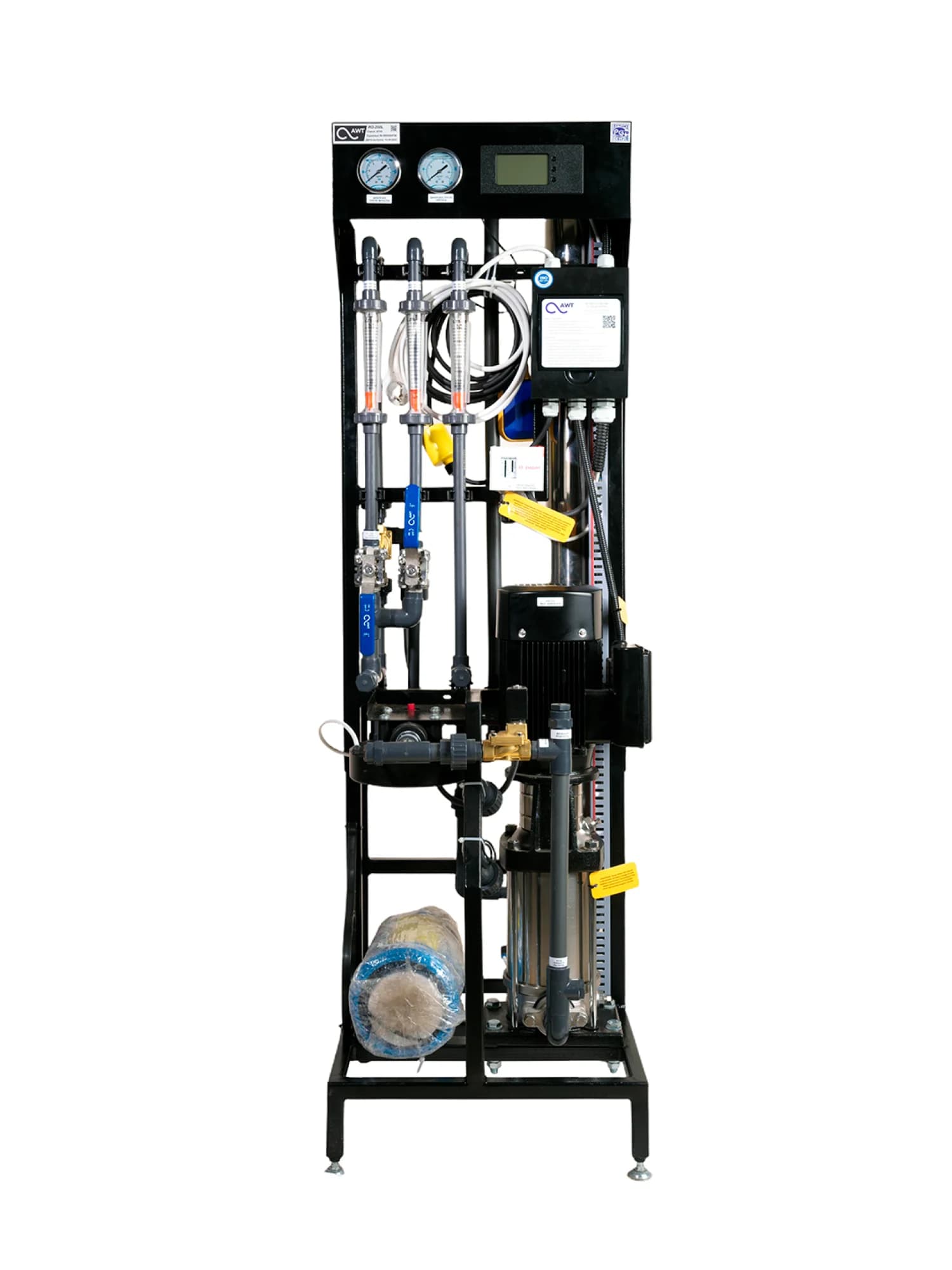
Softening covers the first three. For the final rinse of glass, dealing with hardness is not enough — there the whole dissolved solids content gets in the way, so that water is taken after reverse osmosis: it lowers total mineral content and removes hardness salts, with demineralisation reaching 99 %. The commercial range starts at 250 l/h (SWT RO-250L) and runs up to 2000 l/h (SWT RO-2000L) — enough for a bottling line and for making up solutions. Count the raw water as well: typical recovery for fresh water is up to 75 %, and on the RO-1000L every 1000 l/h of permeate takes 1660 l/h of feed water.
Chlorine, microbiology and taste
The final rinse cancels out the whole wash if the water carries microflora. Acetic acid bacteria and stray yeasts get into the tank and the hoses precisely with the last water, and then live on in dead legs of the pipework and in the texture of an old hose.
Chlorination is the simplest answer to that, but at a winery it comes at a price. Chlorophenols that find their way into barrel wood, into cellar timber or into the walls are converted by microorganisms into anisoles, and at trace concentrations those give wine a musty, corked note. Which is exactly why winemaking prefers reagent-free disinfection.
Ultrafiltration works here as a barrier: PAN hollow-fibre membranes hold back particles from 0.1 down to 0.01 µm — suspended solids, colloids, organics and the larger bacteria — cutting turbidity and colour while leaving the salt composition of the water untouched. For washing that matters: the water stays ordinary process water, just without solids and without biology. UV disinfection goes after it, on the outlet of the clean water tank, to cover secondary contamination in the tank itself.
The seasonal peak: sizing follows the weeks of the crush
The main feature of a winery's water consumption is the calendar. For ten months of the year the site lives on barrel washing, bottling and domestic needs, and during the crush the draw-off rises several times over: the receiving hopper, the destemmer, the press, hoses and tanks are all washed, and all of it in one shift, often back to back.
Hence two ways to get it wrong:
- ✓Sizing on average annual flow. The system will cover the off-season and stop during the crush — exactly when downtime costs the most.
- ✓Sizing on the instantaneous maximum. A unit built for the peak instant stands idle almost all year, and idling is bad for membranes.
The working approach is to calculate the peak daily volume rather than the instantaneous flow, and to add a clean water buffer tank that smooths the surge draw-offs for washing. The unit then runs steadily and can be sized one step lower. The SWT UF range is spaced closely enough to fit the calculation: 2.5 m³/h (2 PAN modules, 27.4 m² area), 5 m³/h (4 modules, 54.8 m²), 7.5 m³/h (4 modules, 82.2 m²), 10 m³/h (6 modules, 100 m²), then 15, 20, 30, 40, 50 and 60 m³/h.
Two numbers catch people out in season. The first is the concentrate: it goes to drain and amounts to 10–20 % of the water fed, so the supply into the site has to carry margin over the useful flow. The second is the water the unit spends washing itself: on the UF-10 that is 1.0 m³/h against 0.75 m³/h on the UF-7.5.
The idle months need a written procedure. Water stagnates in the tank and in the membrane modules, so recirculation or preservation is needed, and deposits are removed by chemical CIP/CEB regeneration with acid, alkali and hypochlorite. The membrane operating range is pH 3–9 and water temperature 5–40 °C, with pH 2–12 allowed in washing modes.
Steam, the boiler room and the cooling loop
A winery has two loops, one heating and one cooling, and both are sensitive to hardness.
Steam and hot water go to barrel treatment, equipment washing and thermal operations. Boiler or steam generator feedwater is always softened: scale in the boiler means not only wasted fuel but also local overheating of the metal.
The fermentation cooling loop consists of tank jackets and a chiller or a cooling tower. Scale on the heat transfer surface reduces heat removal exactly when it is needed most: at the height of fermentation, when the temperature is held in a narrow band for the sake of aromatics. In an open loop with a cooling tower the water evaporates, the salts concentrate, and the make-up has to be softened, otherwise deposits build up within a single season.
What next
Gather the data before any conversation about sizing. On the water — an analysis report: hardness, total mineral content or conductivity, iron, turbidity, microbiology. On the site — daily consumption during the crush and outside it, peak draw-off per shift, a list of points with special requirements (bottling, solutions, barrels), and whether there is a boiler and a cooling loop. Note separately how many weeks the crush lasts: that determines whether a buffer tank is needed and which step of the range will fit.
With these figures you can look at the catalogue: ultrafiltration units provide the barrier against solids and microbiology for all the wash water, while reverse osmosis covers the points where water touches glass and product. If you do not have a water analysis yet, that is where to start: without hardness and mineral content in figures, any sizing for a winery turns into guesswork.