Water for a coffee shop: TDS, carbonate hardness and scale
An espresso machine fails not because of "bad water" in general but because of two different things: scale on the heat exchanger and corrosion of the boiler. The first comes from an excess of salts, the second from their shortage. That is why water for a coffee shop is prepared not to maximum purity but to a specified composition.
The drink is 98% water
An espresso cup contains a few per cent of dissolved coffee; everything else is water together with whatever is dissolved in it. Calcium and magnesium salts take part in extraction: they bind some of the flavour and aroma compounds of the bean and draw them into solution. Bicarbonates act as a buffer — they damp down the acids the coffee releases during brewing.
Hence two symmetrical failures. Highly mineralised water gives a heavy, dull taste and scales up quickly. Fully demineralised water — reverse osmosis permeate with no further treatment — gives an empty, flat cup: there is nothing to extract with, there is no buffer, and the acidity sticks out.
Demineralised water has a second side to it that has nothing to do with coffee. Such water is chemically aggressive: it seeks to make up its shortage of ions and pulls them out of whatever it touches. The boiler, the heat exchanger, the brass fittings and the copper lines of a coffee machine corrode faster in such water than in water of normal mineral content. Industrial schemes with deep demineralisation are built from other materials; coffee equipment is not designed for it.
Three numbers that get mixed up
Baristas and engineers talk about water in different words and often mean different things. Here is what each of the three actually tells you.
| Parameter | What it shows | What it affects |
|---|---|---|
| TDS (total dissolved solids) | the sum of everything dissolved, mg/l | the body of the drink, an "empty" or "heavy" taste |
| Total hardness (GH) | calcium and magnesium together, meq/l | extraction, deposits on surfaces |
| Carbonate hardness (KH) | bicarbonates, alkalinity | scale on heating and the buffering of taste |
TDS is measured with a cheap conductivity meter and so comes up in conversation more often than the rest, but on its own it does not say what the water is saturated with. Two samples with the same TDS behave differently in a machine: one is dominated by bicarbonates, the other by sulphates and chlorides.
For espresso the usual target is a narrow TDS band of around a hundred-odd mg/l — that is a taste reference point, not a standard, and different roasters move it to suit their bean. The practical conclusion is a different one: the band is set from the water analysis report, not from the barista's impression, and it has to be held consistently.
Scale comes from carbonate hardness
The distinction is simple. Calcium and magnesium bicarbonates break down on heating: part leaves as carbon dioxide, and calcium carbonate settles on the hot wall as a dense layer. That is scale. Sulphates and chlorides of the same metals do not precipitate on heating — they count towards total hardness and TDS, but the boiler does not scale up from them.
Control "by total hardness" is therefore misleading. Water with moderate total hardness but dominated by bicarbonates will scale up the boiler, while water with higher total hardness of a sulphate composition will not. A coffee shop needs both figures separately from the analysis report.
Scale is dangerous not in itself but in the way it accumulates. A layer a fraction of a millimetre thick already disrupts heat transfer: the group does not reach temperature, the machine takes longer to recover between shots, and temperature consistency from cup to cup disappears. Then the level sensor and the valves scale up, and the repair costs more than a year's supply of cartridges.
Osmosis with a blend-back, not osmosis as it comes
The working scheme for a coffee shop is reverse osmosis plus a return of part of the raw water. The membrane removes almost all the mineral content, then a metered share of raw water is blended into the permeate, or the permeate is passed through a remineraliser — a cartridge with soluble media that gives calcium and magnesium back to the water. That is how the composition is set: the blend-back share is the control for TDS and hardness.
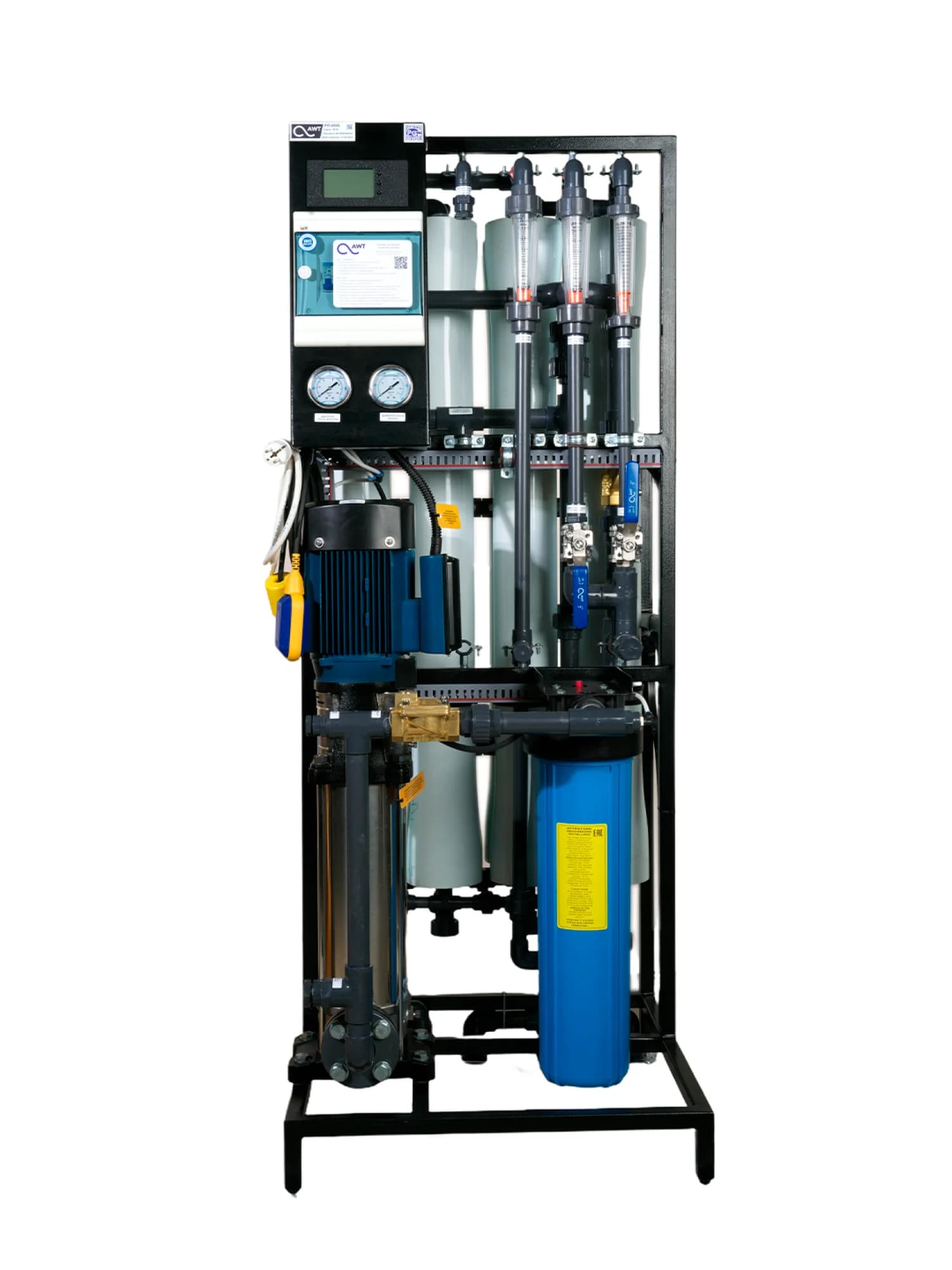
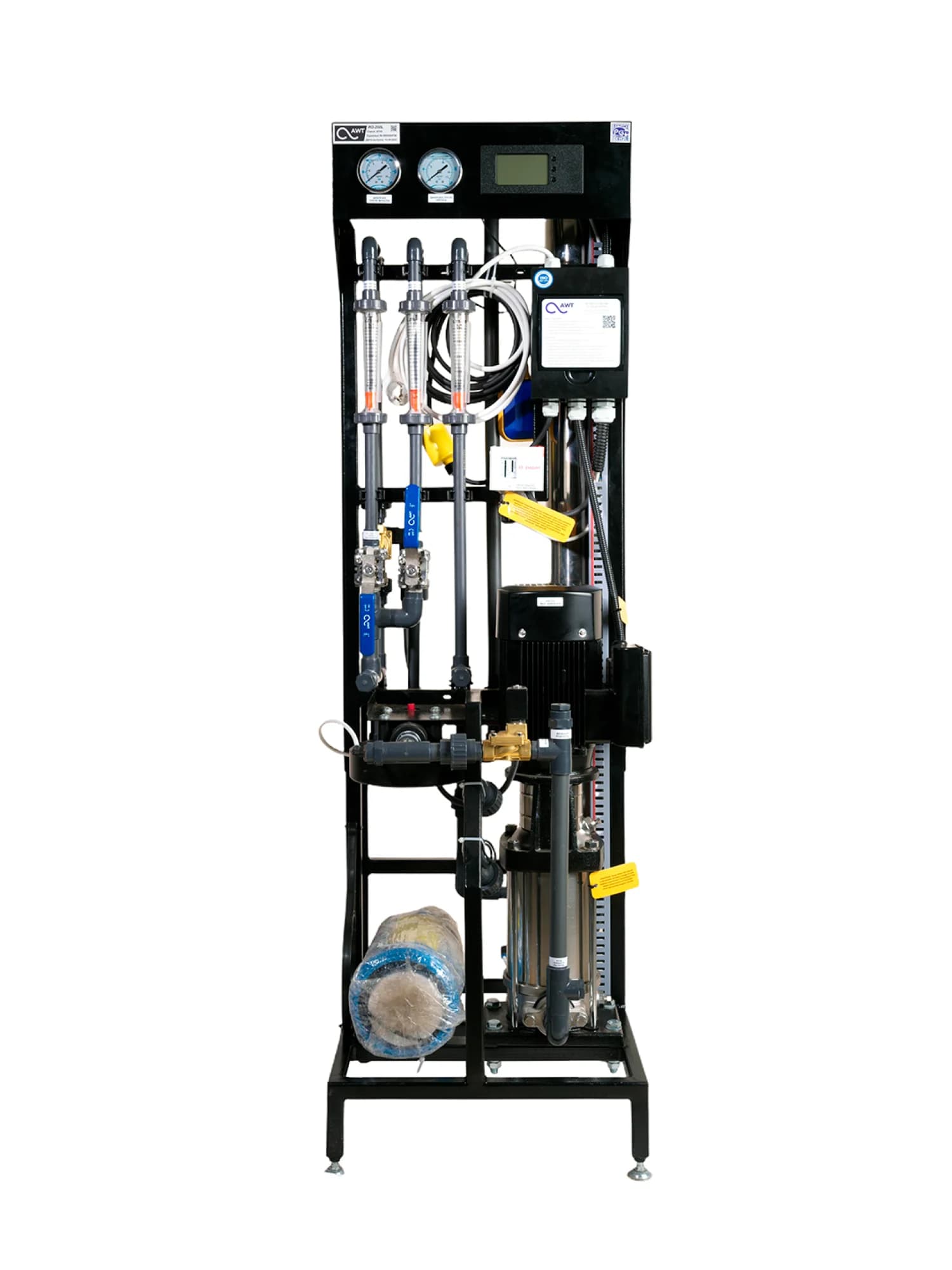
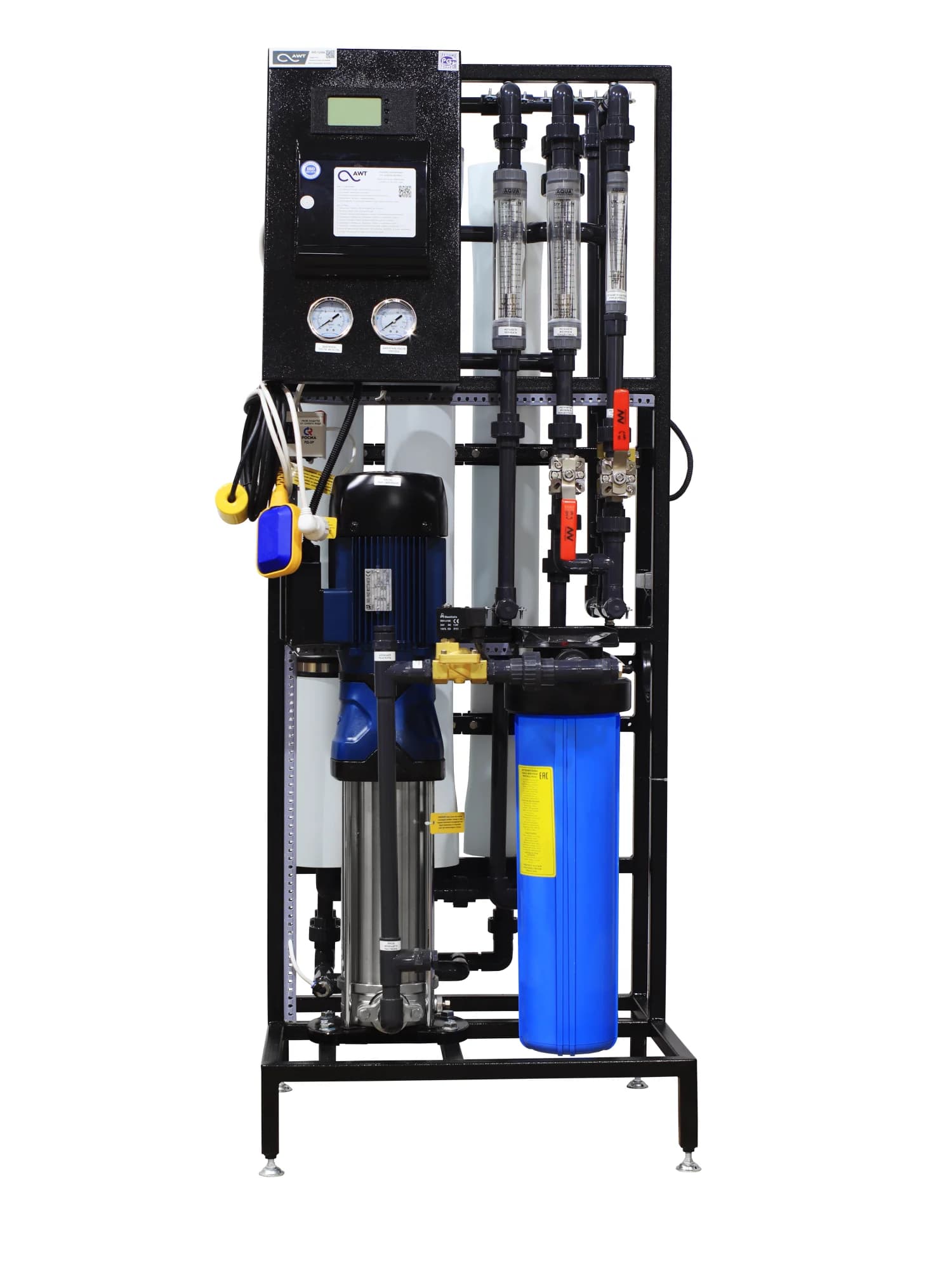
The commercial SWT RO series is built this way. The range runs from the RO-250L (1/4040) at 250 l/h to the RO-2000L (8/4040) at 2000 l/h, and capacity is built up by the number of 4040 membrane housings: the RO-750L has three, the RO-1000L four, the RO-1250L five. A 0.75 kW pump is fitted on the compact ROL-250L and ROL-500L, 1.5 kW on models up to and including the RO-1250L, and from the RO-1500L the series moves to 2.2 kW.
Three things a coffee shop forgets to allow for in advance:
- ✓Raw water consumption exceeds output. Typical recovery for fresh water is up to 75%: in production mode the RO-1000L takes 1660 l/h for 1000 l/h of permeate, the RO-1250L takes 1950 l/h for 1250 l/h. The rest goes to drain as concentrate, and the supply and the sewer connection have to take it.
- ✓Space and connections. The models in the series measure 610×585×1630 mm with a dry weight of 140–160 kg. The connection size grows with capacity: G¾" on the mid-range models, G1" from the RO-1500L onwards.
- ✓Membrane servicing. Hydraulic flushing runs at 4000–4400 l/h, and a separate CIP inlet is provided for chemical cleaning. A replaceable BB20 mechanical filter cartridge works ahead of the membranes — it is changed on schedule, otherwise solids settle on the membrane.
A venue has more than one coffee machine
Treated water is needed by more than the espresso group, and the appliances have different requirements.
A combi steamer boils water in a steam generator — the fastest way to get scale in a venue, and here it is carbonate hardness that matters. A dishwasher is sensitive to total dissolved solids in a different way: salts are left on glass as streaks after drying, so for a dishwasher low TDS is a plus and buffering is irrelevant. For an ice machine, turbidity and mineral content spoil the clarity of the ice and speed up scaling of the evaporator.
Hence the practical consequence: a single water treatment point for the kitchen is usually built on osmosis, and the lines then diverge. Blended water goes to the coffee machine, unmodified permeate to the dishwasher and the ice machine. Where taste is not involved, softening alone sometimes does the job: it removes calcium and magnesium but leaves total dissolved solids unchanged, so as the only stage it is no good for coffee.
Peak flow is calculated across all consumers at once, allowing for the hour when the coffee machine and the dishwasher are both running. A buffer tank after the osmosis unit smooths the peaks and allows a smaller unit than the sum of the instantaneous flows.
What next
Sizing needs four figures from the analysis report: TDS, total hardness, carbonate hardness (alkalinity) and chlorides. Add to them the kitchen's daily consumption and the peak hourly flow at maximum load, calculated across all appliances rather than the coffee machine alone.
With these figures you can look at equipment for coffee shops and restaurants: it brings together reverse osmosis units from 250 to 2000 l/h, which is what a blend-back scheme is built from. If you do not have a water analysis yet, start there — sizing by the taste of tap water gives you either scale or an empty cup.