Municipal water at home: what a house and a flat actually need
On a municipal supply, half the work is done before the water reaches you: it has already been clarified and disinfected at the treatment works. What is left is a different set of problems — hardness, residual chlorine, secondary contamination from old pipework. Here is which equipment answers a real problem and which gets installed simply because it is easy to sell.
What is left in the water after the utility
A borehole gives you water as it is: iron, manganese, hydrogen sulphide, turbidity, microbiology — every stage of treatment falls to the owner, and the system is built around the analysis report. A municipal supply is different: solids have been settled and filtered at the works, and disinfection has been done. That is why the list of problems in a flat or a house on the mains is short and almost always the same.
- ✓Hardness. The works does not remove calcium and magnesium salts — nobody softens water at city scale. From there they behave predictably: scale in the water heater and on heating elements, white marks on taps and shower glass, more detergent than you should need.
- ✓Residual chlorine. The disinfectant has to arrive at the far end of the network still active, so it is in the water by design. That is a question of taste and smell, not of safety.
- ✓Secondary contamination. Between the works and your tap lie kilometres of main and the building's own pipework. The older it is, the more the pipes themselves contribute: rust, deposits, a metallic taste in the first water drawn after the tap has stood unused.
- ✓Sediment after work on the network. A section is shut off, replaced and repressurised, and a wave of deposit torn from the pipe walls travels down the line. It passes quickly, but it is abrasive: tap cartridges, aerators and the solenoid valves in the washing machine and dishwasher take the damage.
Note what is missing from that list: disinfection. A UV lamp on the inlet of a flat repeats work already done at the works, and it is the first sign that the system was assembled without looking at the problem.
Three levels of treatment and what each one solves
Domestic equipment falls into three levels, and mixing them up is expensive: a job done at one level either cannot be done at another at all, or costs you an extra unit.
Mechanical filtration at the inlet. A mesh or cartridge filter immediately after the shut-off valve. It catches sand, mill scale and rust. It is the cheapest item in the system and the only one that is justified almost every time: it protects everything downstream, taps and appliances included.
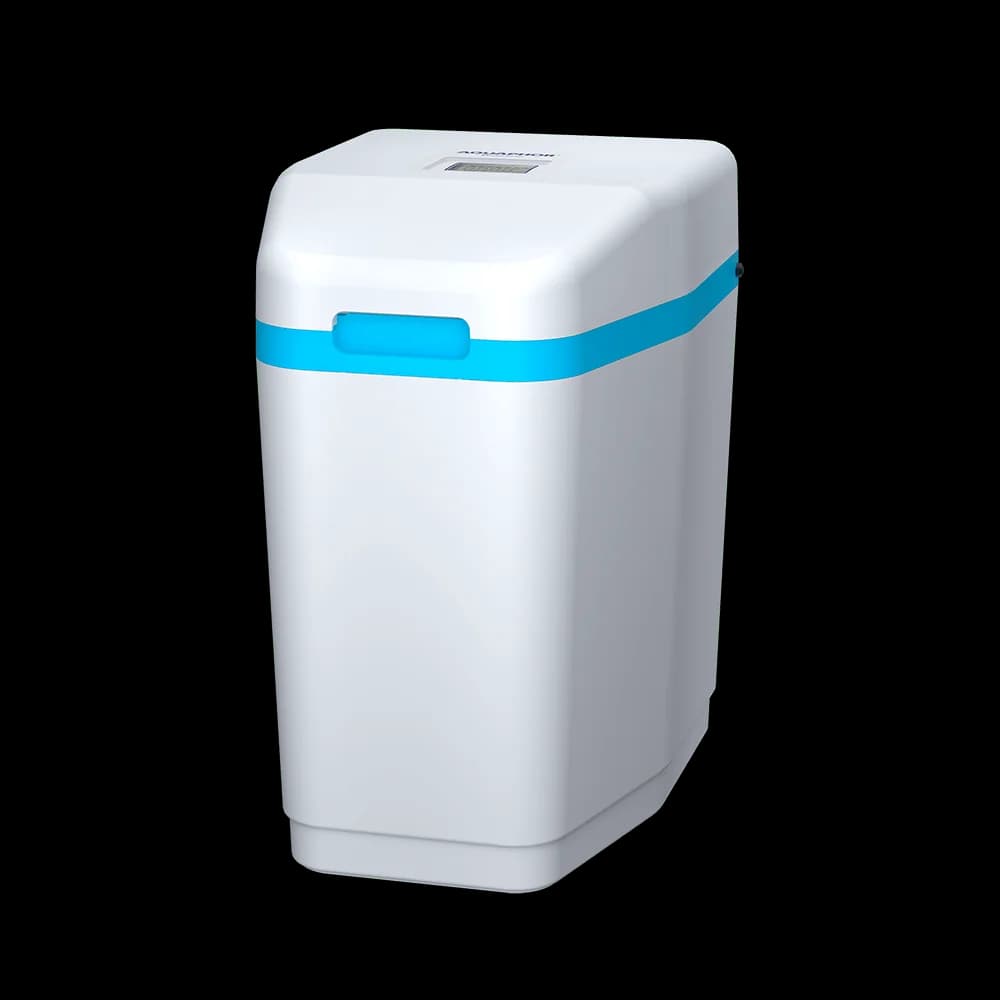
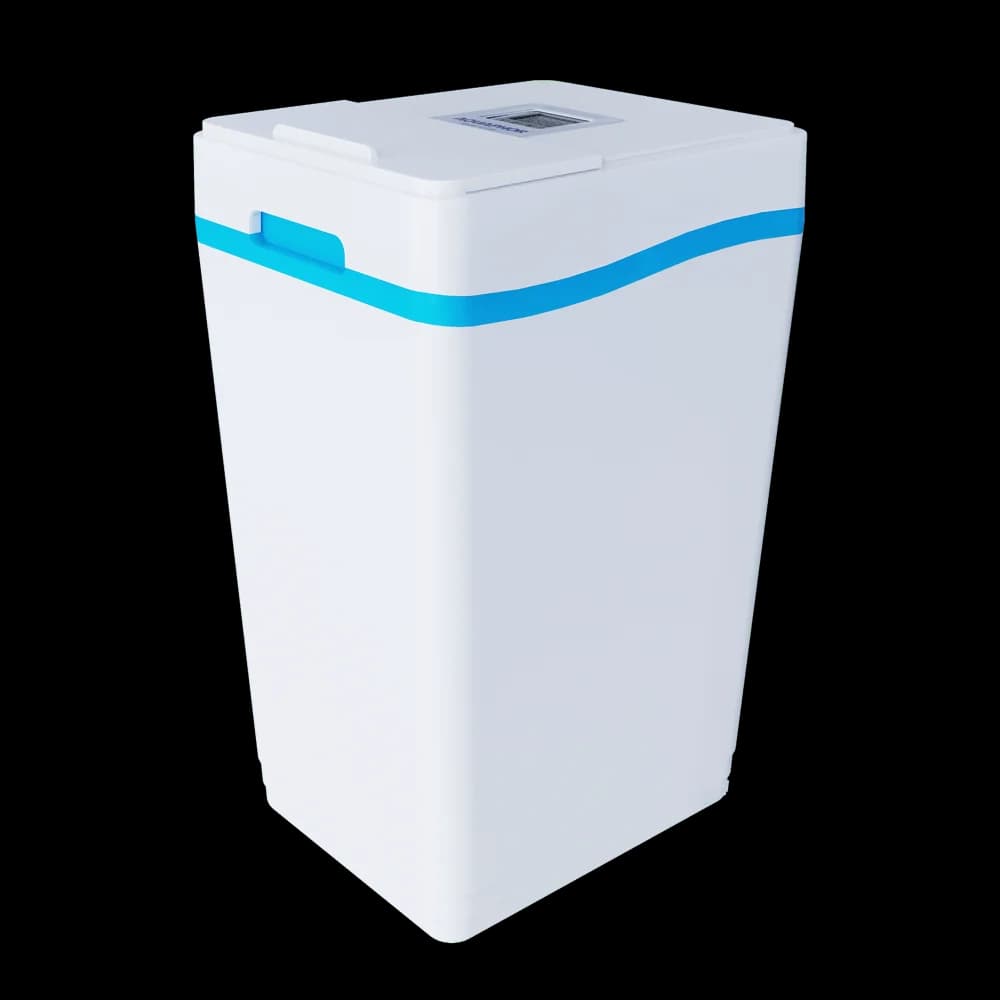
Treatment of the whole supply. Softening, with iron removal if needed. The WS cabinet systems are installed exactly here — as the main filter on the inlet to the house, or as one stage of a treatment train. They are sized by simultaneous draw-off: the WS500 has a working throughput of 23 l/min (1.4 m³/h) and a maximum of 35 l/min (2.1 m³/h), which covers up to 3 taps and a household of 1–3; the WS1000 gives 30 / 45 l/min (1.8 / 2.7 m³/h), up to 5 taps and a household of 5–8. The inlet limits differ too: the WS500 takes hardness up to 24 meq/l, the WS800 up to 28, the WS1000 up to 34 meq/l.
Point-of-use polishing. An under-sink system serving one tap. This is where taste, smell and dissolved solids are dealt with — everything, in other words, that matters only for drinking and cooking. The DWM-101SN Morion reverse osmosis system comes with some of the WS models, and the K7M module puts the mineral balance back into the treated water.
| Problem | Level at which it is solved |
|---|---|
| Sand and mill scale after work on the network | mechanical filtration at the inlet |
| Scale in the water heater and on heating elements | treatment of the whole supply |
| Marks on taps and shower glass | treatment of the whole supply |
| Excessive detergent use | treatment of the whole supply |
| Iron and manganese from old steel pipework | treatment of the whole supply |
| Hydrogen sulphide (odour) | treatment of the whole supply, P1 version |
| Chlorine smell and taste in drinking water | point-of-use polishing |
| Dissolved solids for a coffee machine | point-of-use polishing |
The table makes the main point: an under-sink unit will not save your appliances, and an inlet unit will not fix taste and smell. They are two separate budgets, and neither substitutes for the other.
When whole-house softening is worth it
Hardness does not damage all plumbing equally — it shows wherever water is heated. A cold riser never furs up.
Hence the fork in the road. If the only heating equipment in the house is an electric water heater and a washing machine, and the report shows moderate hardness, softening the whole supply is overkill: protecting those two is cheaper. Whole-house treatment starts to pay for itself when there are many heating points and they are expensive: a gas boiler with a plate heat exchanger, underfloor heating, a dishwasher, heavy hot water draw-off across several bathrooms. There is a domestic argument on top of that — hard water is hard on skin, hair and fabrics, and in a private house people usually react to that before they react to scale.
Two things are not always allowed for. The first is regeneration. In WS systems the controller triggers regeneration from a built-in flow meter rather than a timer, so uneven draw-off does not make the unit burn salt for nothing. Consumption per cycle depends on the mode chosen: on the WS500 the HE mode uses 0.8 kg of salt and 43 l of water over 15 minutes, and the deepest mode, AU, uses 3.3 kg and 65 l over 28 minutes. The second is the drain. Rinse water goes to the sewer, the WS500 sends at most 9.1 l/min to drain, and there is no surge discharge, so the system can live alongside a biological septic tank. In a house with its own treatment plant, check this before you buy rather than after.
How to tell a real problem from an invented one
The usual routine starts with a call offering a free water test at your home. Then come two demonstrations. A drop of water is evaporated on a piece of glass to show a white ring. Or an electrolyser is dropped into a glass and produces brown foam. Both show the same thing: the water contains dissolved salts. That is true of any water, bottled drinking water included, and the trick yields neither a number nor a diagnosis.
Signs that the selection is being done seriously:
- ✓they name specific parameters and their values instead of "your water is terrible";
- ✓they work from a laboratory report, not from a drop evaporated on glass;
- ✓they ask about simultaneous draw-off and the number of outlets, not just the floor area;
- ✓they raise the drain, the space and the salt loading before they name the system;
- ✓they do not offer to disinfect water that has already been disinfected;
- ✓they are willing to say that some of the problems do not need solving on this site.
The last point tells you the most. A system with everything in it at once — mechanical filtration, softening, iron removal, UV and osmosis — on a municipal supply almost always means nobody looked at the problem.
Space, pressure and servicing in a flat
Dimensions decide the question more often than throughput does. The WS500 is 37 × 47 × 56 cm, 35 kg gross, with a footprint of 32.2 × 43.2 cm; the WS1000 is 41 × 50 × 80 cm and 48 kg. A cabinet that size goes in the boiler room or a utility room of a house. A flat rarely has anywhere to put it, and no amount of wanting changes that.
The second constraint is the drain. Regeneration needs a discharge point to the sewer near the unit, with an air gap; the 2.5 m drain hose supplied with the WS500 sets the real limit on the distance. The third is the inlet conditions: WS systems work at pH 6 to 9 and water temperature 5 to 38 degrees, with a 1″ male thread connection and a 12 VAC supply.
Servicing splits by the same three levels. At the inlet — flush or replace the mechanical cartridge. On the softener — top up the tablet salt; the resin itself is not a consumable. Under the sink — change the modules on schedule.
The practical conclusion for a flat: mechanical filtration at the inlet plus under-sink polishing is the realistic set. Softening the whole supply stays a house scenario, where there is space, a drain and heating equipment worth protecting.
What next
Collect six figures and the selection stops being a conversation about impressions: hardness from a laboratory report, iron and manganese, whether there is a smell of hydrogen sulphide, simultaneous draw-off in the peak hour, the number of people in the house, and finally the space at the inlet and the distance to the sewer.
With those in hand, look at 3-in-1 filters — cabinet systems for the whole supply, in versions for hardness, iron, hydrogen sulphide and organics. If you have no analysis report yet, start with that: on municipal water it is usually short and cheap, and without it any selection turns into a list of everything in the warehouse.