Borehole water in a private house: from analysis to treatment train
Your own borehole frees you from water bills, but in exchange it hands you a job a mains supply does not: nobody checks the water composition except the owner of the house. The borehole on the neighbouring plot proves nothing either — water from different aquifers varies enormously. Here is what the analysis shows and how a treatment train grows out of its figures.
What is usually found in borehole water
Borehole water differs from surface water in one respect: it has never been in contact with air. Hence the set of typical findings.
Dissolved iron. Down in the aquifer it is in its ferrous form and invisible: the water runs clear from the tap, then turns yellow in the bucket half an hour later and leaves a rusty sediment. Oxygen from the air has oxidised the iron — and the same thing happens in the boiler, in the washing machine and on the laundry.
Manganese. It travels alongside iron, oxidises more slowly and leaves black streaks on sanitary ware. The analysis report gives it a line of its own, because media that remove iron do not always cope with manganese.
Hydrogen sulphide. A rotten-egg smell, often bacterial in origin. It is corrosive and spoils the taste of the water even in trace amounts.
Hardness. Calcium and magnesium salts from limestone aquifers. They mean scale in the boiler, deposits on taps and more detergent than you should be using.
Turbidity and suspended solids. Sand and clay particles, especially in a young borehole and after the water table rises with the season.
Microbiology. Not tied to depth directly: ingress through a leaking wellhead, or a source of contamination nearby, can put it in any borehole.
Each of these is handled by a stage of its own, and the number of stages is the main fork in the design.
Why the stages sit in exactly this order
A treatment train is put together on one rule: every stage protects the next one as well as doing its own job.
- ✓Mechanical filtration at the inlet. Sand and scale wear out pumps and control valves. It comes first.
- ✓Oxidation. Dissolved iron, manganese and hydrogen sulphide are first converted into an insoluble form, by contact with air or with an oxidant. Skip this step and the filter media will not hold the iron back: media catches flocs, not dissolved ions.
- ✓Iron removal filter. It takes out what precipitated at the previous step.
- ✓Softening. It goes after iron removal, never before. Ion exchange resin binds iron and organics irreversibly: they eat into its capacity, the softener starts regenerating more often than it was designed to, and the resin's service life is cut short.
- ✓Fine mechanical filtration. It catches media carry-over and protects the final stages.
- ✓Disinfection. Ultraviolet only works on clarified water: turbidity and iron screen the radiation, and the dose never reaches the microorganisms. That is why UV sits at the end of the line, not at the inlet.
- ✓Drinking water polishing. A separate point in the kitchen, see below.
Swap any two stages around and the result is usually not "slightly worse" — it wipes out the effect of one of them altogether.
Peak flow is calculated by fixtures, not by the number of residents
The number of residents sets the daily consumption, but equipment is sized by the instantaneous flow — what the house draws at the moment several fixtures are open at once. In a house of four, the morning hour means a shower, a kitchen tap and a washing machine running together, and that moment is what decides whether the capacity is enough.
How to work it out:
- ✓list every draw-off point: taps, showers, toilets, washing machine and dishwasher, irrigation;
- ✓mark the ones that genuinely run at the same time — irrigation and a shower usually fall at different hours, the kitchen and the bathroom do not;
- ✓add up their flows, reckoning on roughly 6–8 l/min per open fixture;
- ✓compare the total with the working capacity of the unit, not the maximum.
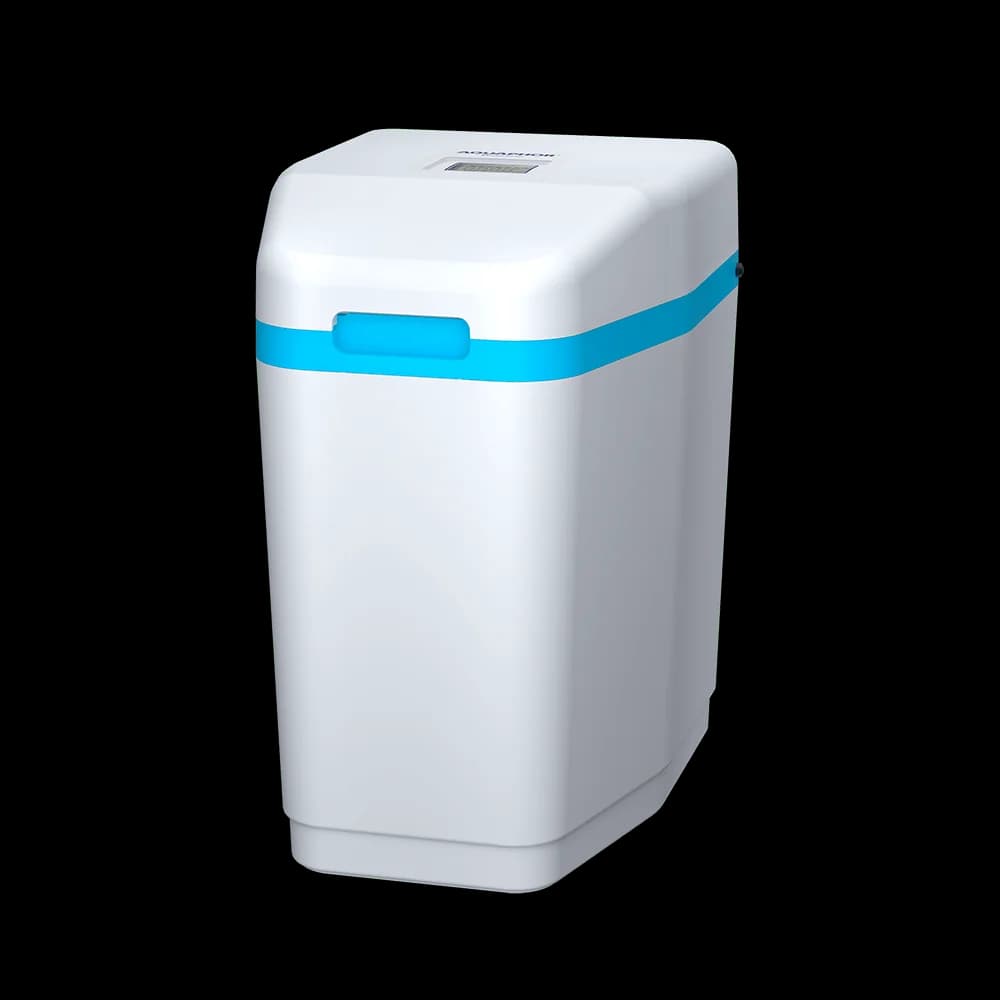
The gap between working and maximum flow matters. Aquaphor cabinet systems in the WS series quote both: for WS500 it is 23 l/min (1.4 m³/h) working and 35 l/min (2.1 m³/h) maximum, for WS1000 it is 30 l/min (1.8 m³/h) and 45 l/min (2.7 m³/h). The maximum is what the system will take for short bursts; size a unit by that figure and the water at peak runs through the media too fast to be treated properly.
One cabinet system or separate tanks
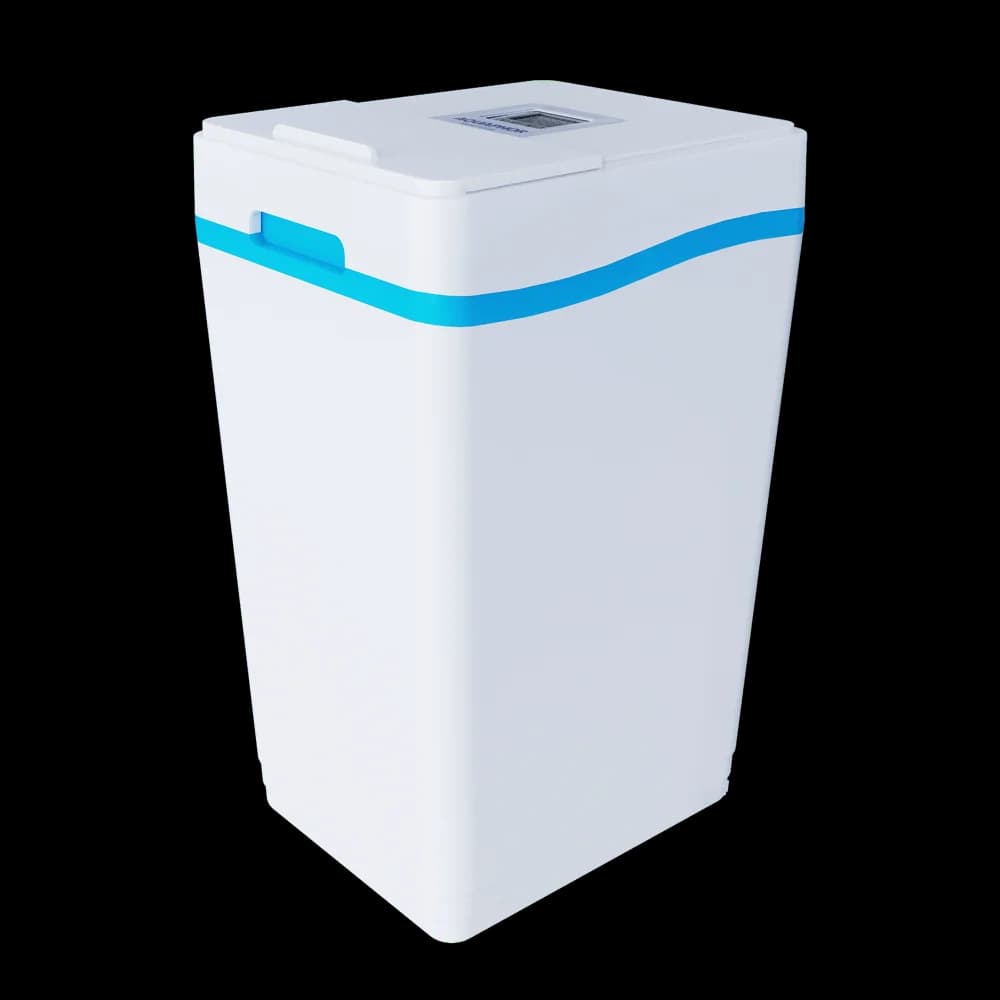
In a private house the job is often covered by a single cabinet system — softening and iron removal in one housing under shared controls. The Aquaphor WS series is built this way; the models differ in their contaminant and flow limits.
| Model | Hardness | Iron and manganese | Flow (working / max) |
|---|---|---|---|
| WS500 | up to 24 meq/l | up to 10 mg/l, manganese up to 3 | 23 / 35 l/min |
| WS800 | up to 28 meq/l | up to 12 mg/l | 25 / 38 l/min |
| WS1000 | up to 34 meq/l | up to 14 mg/l, manganese up to 5 | 30 / 45 l/min |
| WS1000 A | up to 24 meq/l | up to 5 mg/l, manganese up to 3 | 25 / 38 l/min |
The letters in the model name are not versions, they are different jobs. P1 adds hydrogen sulphide up to 1 mg/l to the base configuration: that is what WS500 P1, WS800 P1 and WS1000 P1 are. A means media for organics: WS1000 A removes humic and fulvic acids (permanganate oxidisability up to 10 mg O2/l), but it takes a lower load on hardness and iron than WS1000 without the letter. So for organics there is only one model to choose, and you pay for it in hardness capacity.
By draw-off points: WS500 is meant for a family of 1–3 and up to 3 taps, WS1000 A for up to 4 taps and a family of up to 5, WS1000 for up to 5 taps and a family of 5–8. The housing grows with the load: 37×47×56 cm and 35 kg for WS500 against 41×50×80 cm and 48 kg for the thousand group.
Three things to check before ordering. First, pH and temperature: WS systems work between pH 6 and 9 and between 5 and 38 °C, and water outside those limits needs a different solution. Second, where the backwash goes: the controller times regeneration from a built-in flow meter rather than a calendar, and the modes differ in how much salt and water they use (WS500 ranges from 0.8 kg of salt and 43 l of water in 15 minutes to 3.3 kg and 65 l in 28 minutes). Nothing is dumped to drain in one slug — WS500 drains at 9.1 l/min at most, so the system is compatible with a bio-septic tank. Third, the connections: 1″ ports and the supply piping set the pipework in the boiler room.
Drinking water polishing goes separately
There is no need to bring the whole house up to drinking quality: irrigation, laundry and showers do not call for it, and you would be paying for every cubic metre. So the line is split. Main-line treatment takes iron, hardness and turbidity out of the water for the whole house, and the kitchen gets a point of its own.
Under the sink goes reverse osmosis — the DWM-101SN Morion, for instance, which is supplied as a companion to the WS series. The membrane removes residual salts, organics and microbiology, and the K7M module puts the mineral balance back into the drinking water: water stripped of all its salts tastes flat and is not what you want to drink day after day.
Osmosis under the sink does not replace main-line treatment. It is designed for water that has already been through the earlier stages; feed it raw borehole water and the membrane will clog with iron within weeks.
What next
Start with the analysis report. To size anything you need iron and manganese reported separately, total hardness, hydrogen sulphide, turbidity, permanganate oxidisability, pH and microbiology. Add the daily consumption and the peak flow worked out from the draw-off points — without those two figures, sizing is guesswork.
With the figures in hand, look at 3-in-1 filters — cabinet systems for the main line — and household water treatment, the base configurations of the same series. Choose the drinking point in the kitchen once the main-line scheme is settled, not instead of it.