Winery effluent: surges, acid pH and why equalisation comes first
Winery effluent is almost entirely wash water, and it behaves nothing like municipal sewage: a few weeks of back-to-back surges, then a lull for the rest of the year. A scheme sized on average flow will not cope with the crush — it is swamped on volume, on organics and on pH alike. Here is what goes into that effluent, and the order in which the treatment stages take it apart.
The harvest calendar matters more than the daily curve
Out of season a winery produces little: domestic sewage, barrel and container washing, floor cleaning. During the crush the picture changes within a week. The receiving hopper, the destemmer, the press, hoses, pumps and tanks all get washed — and every wash ends with the whole volume of the loop dumped into the sump at once.
That gives two figures you have to know separately, and at a winery they diverge further than at any other food plant: flow in season and flow out of season. Size the equipment on the annual average and it will choke in September and October. Size it on the instantaneous peak of a surge and it will be enormous, standing idle for ten months — and a biological stage does not take kindly to standing idle.
There is a third quirk: the gaps. Between surges the plant can sit for hours and then get everything at once. A steady inlet flow has to be engineered.
What actually goes down the drain
The composition of the wash water changes over the course of the season, and each phase contributes its own load.
- ✓Reception and crushing. Washed-off juice, crushed pulp, fragments of skin and stem. Heavy in suspended solids, with coarse debris.
- ✓Pressing. Wash water carrying must residues — concentrated, high in sugars.
- ✓Fermentation and transfers. Washed-off must and wine residues, yeast lees from the bottom of the tanks, water from washing hoses and pumps.
- ✓Racking and filtration. Yeast lees, diatomaceous earth or other filter aids where they are used.
- ✓Vessel washing. Dissolved tartrates after the caustic stage of CIP, mineral salts after the acid stage.
- ✓Bottling. Rinsing of bottles and returnable containers, wash-down from the line.
The organics in this effluent are readily oxidisable — sugars, alcohol, organic acids — and a biological stage handles them happily. But nitrogen and phosphorus are scarce relative to carbon, so the biology has to be fed, not just relieved of organic load. The solids are not uniform either: some of it settles quickly, some — the yeast haze — stays in suspension for a long time.
Coarse debris should never reach the drain in the first place. Stems, pomace and pressed pulp are production waste: take them out mechanically on a screen or a sieve and haul them away separately — in Georgia pomace usually goes for distillation. Whatever never enters the sewer will not have to be pulled back out of it. At sites working with qvevri, vessel washing adds to the list: lees from the bottom and lime particles from the outer coating end up in the effluent.
pH: the effluent is acidic, and after CIP alkaline
Wash water carrying must and wine residues is acidic: it is acidified by tartaric, malic and lactic acids, and on young wine by residual sulphur dioxide as well. Effluent from the caustic stage of CIP is the opposite — alkaline — and it arrives at the same sump on the same shift.
The result is not an "acidic effluent" but an effluent that swings between acid and alkaline within a single day. For a treatment plant that is worse than a stable shift in either direction: the biology never has time to adapt, the coagulant works outside its window, and concrete and ordinary carbon steel take a load that keeps changing.
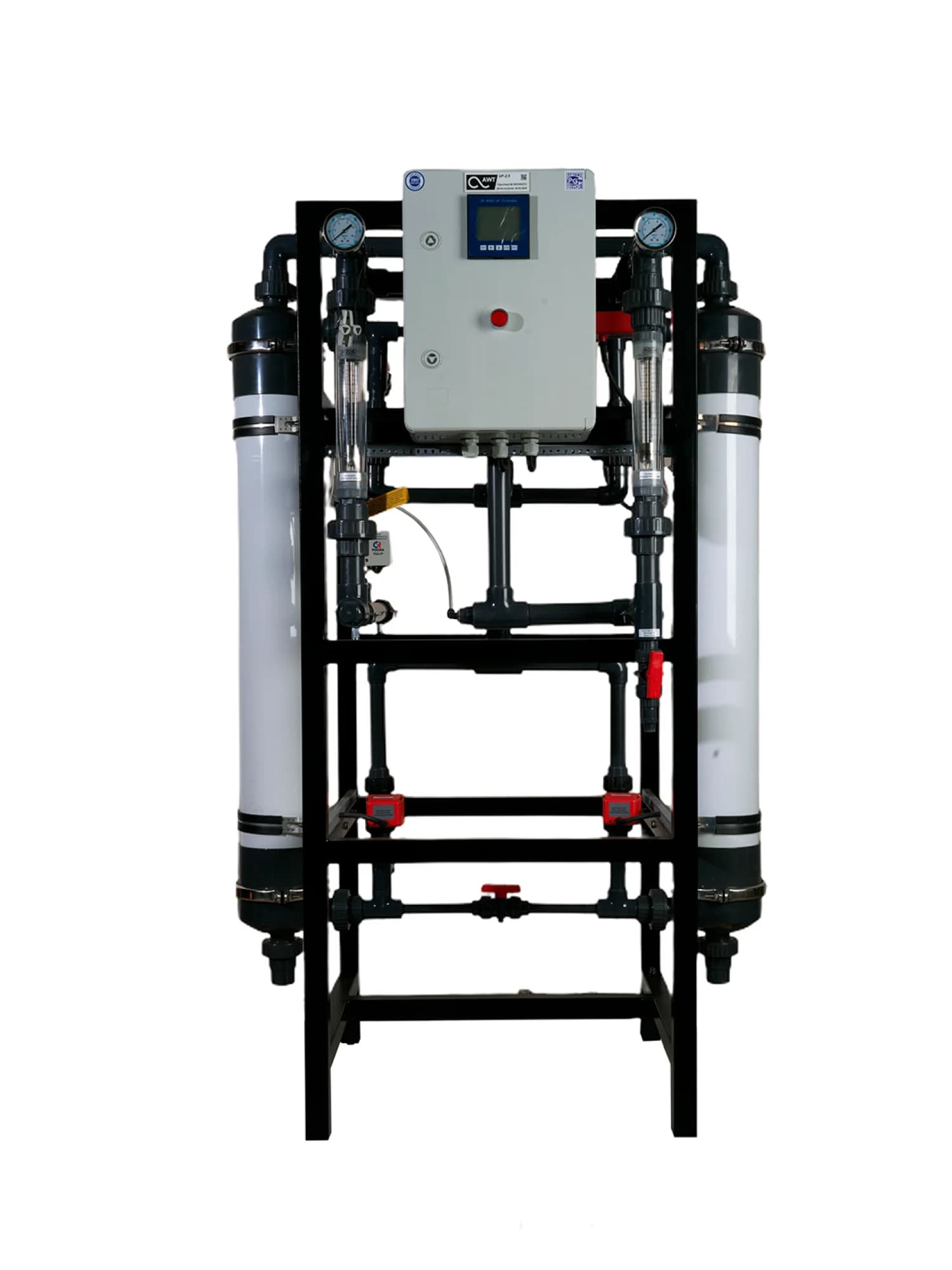
Neutralisation is a mandatory stage here, and it runs automatically from a pH sensor on two reagents — acid and alkali — each with its own dosing station. A dosing station combines the metering pump, the tank and the pipework into a single unit: the range runs from a 60 l tank with a dn15 connection up to a 200 l tank with dn50, 220 V supply. Versions with a digital pump (HG30) let you set the dose and the mode from the panel; analogue ones (HP30) are set with a knob — for control from a pH meter signal, take the digital ones.
A word on discharge limits, plainly: they are set by the water utility or the local regulator, and every discharge permit is site-specific. Get those figures in hand before you size anything — they decide whether mechanical treatment with neutralisation will do or whether a biological stage is needed as well.
The equalisation tank is not optional, it is the basis of the scheme
At a winery the equalisation tank solves three problems at once, and there is nothing else to solve them with.
- ✓It smooths the surges. It takes the whole discharge from a wash and passes it on to treatment at a steady flow held by a pump.
- ✓It mixes the streams. Acid wash water and alkaline CIP effluent partly neutralise each other before any reagent is dosed — acid and alkali consumption drops.
- ✓It evens out concentration. Strong wash water from the press is diluted by water from floor cleaning and bottling, so the stages downstream never take a shock load of organics.
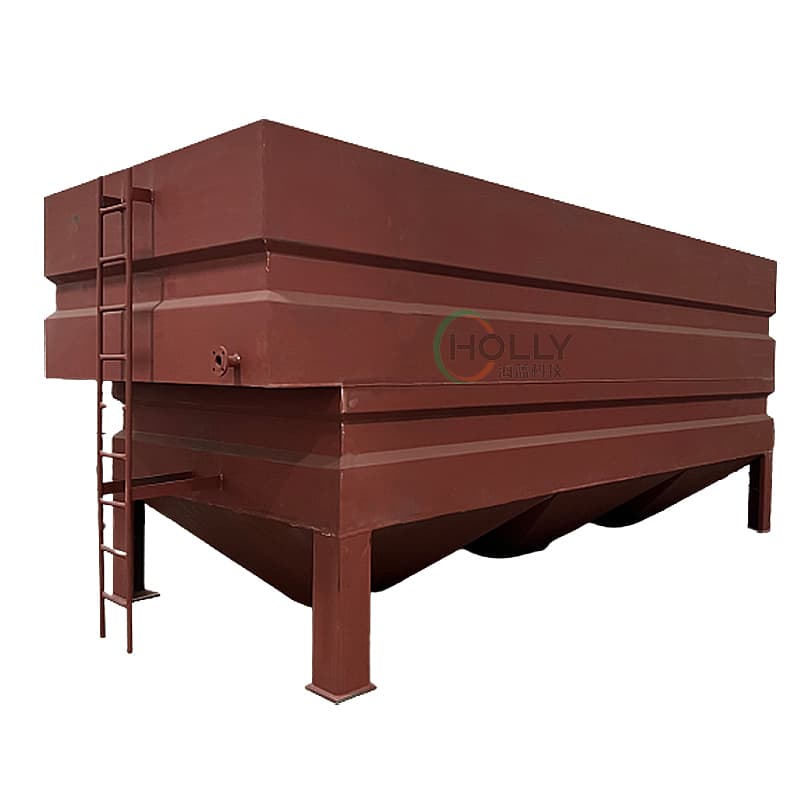
Size the volume from the daily curve of the season, not from average flow: the tank has to take the peak and release it over a day. It needs mixing inside, or the solids settle and the organics in that settled layer start to sour within hours, adding smell and acidity to the effluent. For the same reason the tank is often aerated.
The economics are simple: the equalisation tank is the cheapest vessel in the scheme, and it lets everything downstream be sized on flow rather than on a surge. A lamella clarifier for 10 m³/h is noticeably cheaper and more compact than a unit sized for the instantaneous peak of a wash.
Clarification: clarifier, DAF unit and sludge
After neutralisation the effluent is clarified. Two main pieces of equipment address different parts of the task.
| LC lamella clarifier | DAF unit | |
|---|---|---|
| Principle | settling in a pack of plates at 60° | dissolved air flotation, bubbles lift the contaminants |
| What it removes | settleable solids, floc after coagulation | light and emulsified matter, fats, fibre |
| Moving parts | none | pressure pump, mixers, skimmer |
| Power consumption | low | drive from 3 kW (DAF-10) to 15 kW (DAF-100) |
| Flow range | 1, 2, 3, 5, 10, 20, 30, 40, 50, 120 m³/h | 2–2.5 to 95–100 m³/h |
| Servicing | no specially trained operator required | automatic, with remote monitoring |
For winery effluent, where the main load is settleable solids and floc after coagulation, the lamella clarifier is usually the working choice. The inclined pack multiplies the settling area for the same footprint, so the unit takes up less space than a classic horizontal clarifier: LC-10 for 10 m³/h measures Ø2150×3500 mm. A DAF unit is the answer when the effluent carries a light, poorly settling fraction, or when the load on a biological stage has to be cut before discharge; it comes with built-in coagulation and flocculation chambers and a clarified water tank, and the body is available in 304 and 316L stainless steel among others — which matters with acid media.
Either way you are left with sludge, and in season there is plenty of it: winery effluent yields a lot of organic solids. Empty the clarifier's sludge hopper on a schedule rather than when it overflows — compacted organic sludge sours. Then dewater the sludge so you are not paying to haul water: mechanical dewatering cuts the volume several times over and turns the slurry into a cake you can transport.
What next
Collect four things. First — the site's discharge permit and the list of parameters it controls. Second — the flow, split in two: during the crush and outside it, plus the volume of a single tank-wash discharge. Third — the length of the season in weeks. Fourth — an effluent analysis taken at the height of the crush, not in the off-season: a sample from a quiet month shows figures the treatment plant will never actually see.
With that in hand you can look at the catalogue: lamella clarifiers cover clarification after neutralisation, DAF units handle effluent with a light fraction and elevated organics, and dosing stations are needed for the reagent side of any of these schemes. Start the design with the equalisation tank: it sets the flow that every other stage is sized on.