Hotel effluent: kitchen, laundry and pool in one pipe
A hotel sends three different effluents down one pipe: greasy water from the restaurant kitchen, surfactant-laden water from the laundry and dilute domestic sewage from the rooms. While occupancy is low the sewer copes; in high season you get the smell in the basement, the blockages and the questions from the water utility. Here is where each stream comes from and what equipment deals with it.
Three streams that mix in the basement
The restaurant kitchen produces the heaviest effluent. Grease from the range, the sinks and the dishwasher goes down the drain hot and emulsified; in a cold pipe it sets and coats the walls with a layer that narrows the bore month by month until it closes the pipe off completely. The peaks come at the end of breakfast and at closing time in the evening.
The laundry discharges water carrying detergents and surfactants (surface-active agents). You can spot them with the naked eye: persistent foam in the receiving chamber that never settles and gets in the way of everything downstream. Textile fibre comes along with them.
The pool adds two things: filter backwash water, which arrives in a surge during backwashing, and the periodic draining of the basin. The backwash effluent is small in daily volume but arrives within minutes and at high turbidity, so in a shared pipe it acts as a shock load rather than a flow.
Against all this, domestic effluent from the rooms is the steadiest and the most dilute of the three. It supplies the bulk of the volume, and it is what sets the size of the whole line.
A grease trap is needed, but rarely enough
A grease trap is a gravity vessel: the effluent slows down, grease floats up as the lighter fraction, heavy solids settle, and the clarified middle layer carries on. It sits directly downstream of the kitchen and removes whatever grease has had time to rise.
It has two limitations, and both are built in. The first is time: grease needs still water to rise, and at the restaurant's evening peak the water races through the vessel. The second is the state of the grease. After a dishwasher with hot water and detergent the grease is partly emulsified — broken into fine droplets that never merge into a layer and never rise on their own. Gravity cannot deal with them by definition.
Hence the familiar picture: the grease trap is serviced on schedule and grease still reaches the sewer. Add the surfactants from the laundry, which stabilise the emulsion in their own right, and gravity alone is no longer enough.
Equalisation: why hotel effluent needs a steady flow
Every treatment stage is tuned to a flow and to a composition. A hotel gives you neither: the morning peak is several times the night minimum, and August is several times February. Reagents are dosed by flow and flotation works by residence time, so when the flow swings, both settings miss.
An equalisation tank is a reservoir with mixing and a pump on the outlet. It takes the effluent as it comes and lets it out at an even rate. Three effects:
- ✓the daily peak is smoothed out — equipment is sized for the average design flow rather than for the morning maximum;
- ✓the composition is evened out — the surge of pool backwash water is diluted by domestic effluent instead of hitting the flotation unit as a concentrated slug;
- ✓reagent dosing is stabilised — the coagulant and flocculant dose is calculated on a predictable flow.
Without an equalisation tank the next stage has to be sized for the peak — a margin that stands idle nine hours a day.
DAF flotation: what it catches that a settler misses
A DAF unit separates suspended solids, fats and oils by dissolved air flotation. Air is dissolved in water under pressure, and when the pressure is released it comes out as a cloud of very fine bubbles: they attach to contaminant particles and lift them to the surface. The floated layer is removed by a stainless steel chain scraper, and the clarified water is drawn off from below. Part of the treated water is returned to the pressure line — this recirculation keeps air saturation stable.
The difference from a settler is fundamental. In a settler, solids sink under their own weight, and light emulsified contaminants — kitchen grease above all — are in no hurry to sink at all. Flotation works the other way round and lifts them out. For a hotel with a restaurant, that is the answer to where the grease that gets past the trap should go.
The coagulation and flocculation chambers and the clarified water tank are built into the housing, so the whole stage takes one footprint instead of three. The housing comes in carbon steel with an epoxy coating, in the same steel with a fibreglass lining, or in 304 and 316L stainless steel for aggressive media.
Sizing goes by the design flow downstream of the equalisation tank.
| Model | Capacity | What it covers |
|---|---|---|
| DAF-2.5 | 2–2.5 m³/h | a small guest house with a kitchen |
| DAF-5 | 4–5 m³/h | a hotel with a few dozen rooms |
| DAF-10 | 8–10 m³/h | a hotel with a restaurant and its own laundry |
| DAF-20 | 15–20 m³/h | a large hotel, several catering outlets |
| DAF-50 | 45–50 m³/h | a resort complex |
| DAF-100 | 95–100 m³/h | a group of buildings on one site |
With these models, look at the space they need as well as at the capacity. DAF-10 is 4500×2100×2000 mm, a 3 kW drive and a pressurised water flow of 3.5 m³/h. DAF-100 is already 10000×3000×3000 mm, a 15 kW drive and 50 m³/h of pressurised water. A plant room for a stage like this is planned in advance, not hunted for after the order is placed.
Smell and sludge: what is left after treatment
Smell in a hotel is not a cosmetic problem but the reason for complaints and for moving guests to other rooms. It arises wherever effluent stagnates without access to oxygen: in an overfilled grease trap, in an unventilated receiving tank, in an equalisation tank without mixing. The cure is a routine, not air fresheners: pump the grease trap out regularly, keep the equalisation tank mixing, ventilate the room and seal the lids on the vessels.
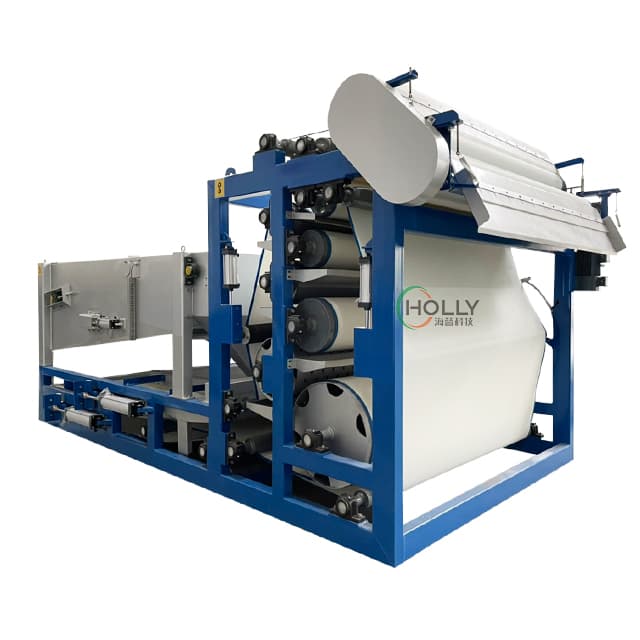
The second underestimated item is float sludge. A flotation unit does not destroy grease, it concentrates it in the floated layer, and that layer has to go somewhere. Skimming is set to the actual amount of sludge, and then the question of volume starts: hauling watery sludge away by tanker is expensive, so it is dewatered first. Screw presses such as DS-201 run flow-through and suit small steady volumes; the FP 1000A and FP 2000A belt presses take a larger flow; the CFP80 and CFP200 chamber filter presses work in cycles and give a cake of low moisture content where the sludge is viscous or very wet.
A word on discharge requirements. The limit values are set by the water utility or the local regulator, and every permit carries its own. Take those figures from your own permit before you work out a scheme — the hotel down the road in the same city may be discharging under different conditions.
What next
Collect four things. First, the daily effluent volume and its breakdown by source: rooms, kitchen, laundry, pool. Second, the daily profile: when the peaks come and how far above the baseline they are. Third, seasonality: the flow in a high and a low month. Fourth, the conditions of your discharge permit, because they determine whether mechanical treatment with flotation will be enough or a further stage will be required.
With these figures, look at the industrial wastewater treatment section: DAF flotation units, lamella clarifiers and sludge dewatering equipment are gathered there together. It is almost always worth starting from measured flow rather than from a calculation based on room count: a hotel with a full restaurant and a hotel serving only breakfast produce different effluent at the same capacity.