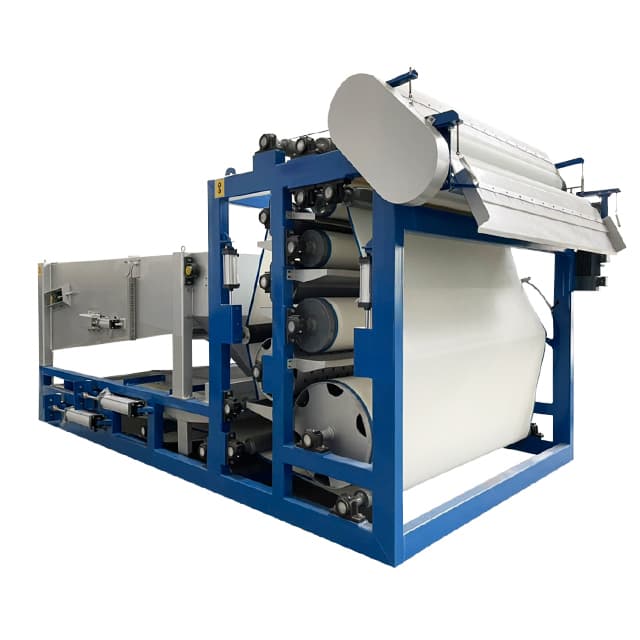
FP 2000B belt filter press
FP 2000B, water flow rate 22.4 m³/h
The mid-range FP designs run continuously: sludge moves as a flow, without the "fill chambers — open plates" cycle that a chamber filter press lives by. After the gravity section the belts form an S-shaped path, the wedge between the rollers presses the layer further, and cake is discharged at the outlet.
The belt width of this subgroup covers the main demand of municipal wastewater treatment plants and medium-sized industrial sites — petrochemicals, chemical fiber, pulp-and-paper and pharmaceutical production.
The press handles organic hydrophilic and inorganic hydrophobic materials equally well. Sludge is fed into the flocculant mixing unit, where flocs have time to form before reaching the belt. With a variable wastewater composition, the operating mode is adjusted by belt speed and reagent dose, without touching the mechanics.
FP 2000B design: capacity by dry solids 400–460 kg/h, drive power 1.1 kW, working belt width 2000 mm, water flow rate 22.4 m³/h.
By water flow rate it sits between FP 2000A (20.8 m³/h) and FP 2500A (24.1 m³/h): 22.4 m³/h. Capacity by dry solids 400–460 kg/h — the same as on FP 2000A. Working belt width 2000 mm — the same as on FP 2000A.
One step up by water flow rate — FP 2500A: drive power 1.5 kW instead of 1.1 kW.
Let's talk about your project
Tell us about your site — our engineer will prepare a process design, a specification and a quotation within one business day.